
AMHE Newsletter # 371

Updated: Aug 3

Table of Content of the AMHE Newsletter # 371
1- Words of the Editor-in-Chief: Multiracial and Mixed Race People
2- Rony Jean Mary MD : HAITIENS POURQUOI SOMMES NOUS TOMBÉS SI BAS ?
3- Reynald Altema MD : DEBLOZAY
4- Bertrand Laurent: The Difference Between NGOs and CSOs
5- Requiem AMHE: Roger Yves Leurebours
6- AMHE News, Resident-Program, Activities at The AMHE Convention, Teaching and Medical Missions in Haiti, AMHE Foundation, AMHE Chapters, AMH
7- Maxime J-M Coles MD: Bell’s Palsy
8- Rony Jean Marie MD: LA CONVENTION ANNUELLE DE L’ASSOCIATION MÉDICALE HAITIENNE À L’ÉTRANGER EU LIEU CETTE SEMAINE!
9- Reynald Altema MD: LÉON
10- Aldy Castor MD: Hougans, maçon-loges et autres mystères : ce que j'ai appris des sociétés secrètes haïtiennes
11 Coin des Lecteurs: David Walmer MD OBGYN-HAITI, Questions and Answers to the Lecteurs,
12- Maxime Coles MD: Lisfranc Injuries
13- Rony Jean Mary MD: FBA : fondamental black Américain
14- Reynald Altema MD: The Goose and the Gander
15- Louis Frank Telemaque MD: Info Chir
16-Janvier MD, DNP: Metabolic Syndrome and Immunotherapy
17- Bertrand Laure5nt: How Empires Turn Taboos into Weapons
18- Jean Serge Dorismond MD: Alexandrins de la Sagesse
19- Maxime J-M Coles MD : Moments de Doute
Editorial Board
Maxime J-M Coles MD
Rony Jean Mary MD
Reynald Altema MD
Yasmine Titus Pompey MD
Fahimy Saoud MD
Multiracial or Mixed-race people
I am not sure that terms like “multiracial” or (mixed-race) people is defining people of many races. So many terms appear to have approached the subject without being able to elucidate the confusion which constantly exists in the mind of any human being. I am not sure, exploring the topic, I can say that I found myself being able to describe better the evolution of our actual human society.
We have learned through history books much about racial division during the time of the discovery of our country of Haiti by the Spaniards and the buildup of the different colonies. We understood well how these colonies were populated by Taino’s Indians who later were placed into slavery and forced to perform heavy labor until their population was almost completely exterminated.
Our Caribbeans islands become later populated by blacks taken from their kingdom mainly in Western Africa, to populate these Spanish, Portuguese and French colonies, in the late 1700’s. Perhaps for us, this phenomenon has evolved with expressions used every day by different societies, facilitating the creation of a Multiracialism and this notion of “Mixed Race”.
In our colonies, white colons and slaves began to socialize and many children of mixed races were born. Any person born on the islands was called a “Creole” but any slave in provenance of Africa was called a “Bossale”. Colons started sharing the beds of their slaves or raping them bringing to the world different shades coloured kids called “Mulattoes” which benefited from better privileges because of one of their parents being a colon (white).
These children were catalogued over the years and were given different nomination depending on the percentage of “white blood” in their veins. The child of a mulattoe with a slave was called “Quarteron or Sixteron etc.” If a colon has a child with a native Taino Indians, it becomes a ”Metis”… What a heritage the colonization has left to us…
The same story repeats itself around the world in other societies and the notion of multiple races was born. Probably, it was perhaps present longtime ago but appears to be a little more sporadic. Nowadays, terms like polyethnic, biracial, multiracial appear to have a better use in the common language. Many other terms have been used to pinpoint coloured people, although some may no longer be in usage like Mestizo, Melungeon, Chindian, Zambo, Eurasian, Hapa, Hafu, Pardo, Caboclo, Cafuzo, Ainoko (Japanese), Mistico (Portuguese) etc. but Mulatto (French) remains perhaps the term closer to our history and still in use.
People with multiracial backgrounds made up a significant portion of the population of the world. It becomes difficult to define race, and many remain convinced, in enjoying the recent World Cup’s football (soccer) matches, that we are living in a multiracial society in North or South America, in the Caribbeans with a predominance of blacks or Hispanics depending on the countries visited.
The term “Race“ which remains mostly used in conversations dealing with any kind of multiraciality, still appears to be objective and brings a certain controverse in many discussions. Perhaps one can define it differently depending on their culture or their perceptions.
Many people appearing “white”, may possess genetic markers indicating that their ancestors came from Africa while, others may look black but possess genetic markers from Europeans ancestors. (Troy Duster and Pilar Ossorio). I have in a past AMHE Newsletter debated on the color “Blue” of the eyes as being a genetic marker of European descent (Scandinavia): feature that I found in one of my patients. This colour phenomenon triggered in me, a curiosity to try to discover why a black from Africa or any other place on earth, would be born with eyes of bleu or hazel brown colour generally found in the northern Europe in Scandinavia etc.
Genetic markers were studied and revised as well, in the USA for proper tabulation and presentation of data on race and ethnicity. Five racial categories were identified: White, Black or African American, American Indian and Alaska Native, Hawaiian or Pacific islander. Others may be considered as one or more races.
Still currently used, terms like mulatto (African descent) or mestizo (Native American descent) are often spoken and even in Louisiana another term “Mestee” was often used to designate people from mixed race. In South Africa, during the time of the apartheid, the term “coloured people” was also used to describe mixed-race person of African or Asian descent.
In Latin America, a newer notion of “triracial mixture” with the introduction of the African slavery to the Spanish and indigenous population already present during the colonial period, brought also different terms like “Zambo” (Amerindian and African descent). If one visit Mexico, Peru or even Columbia, illustrations demonstrating different classifications can be seen on the Casta paintings, the same ways that such classifications were described in the colony of Saint Domingue by the French.
In Brazil, with the Portuguese imperial time (Prince), people of multiracial descent were called simply “Pardo” or “Caboclo” while a white Brazilian was called a “Branco”. Others of mixed races of Europeans or American descents were also called Pardo. Some other terms in English like ‘miscegenation” and “amalgamation” are not in use anymore to define unions between black, whites and other ethnic groups. Around the world, let me take the time to mention other areas with this multiracial evidence like the Northen Africa and the Middle East with Afro-Arab, Afro-Iranians, Afro-Turks.
In the Sahara, the Haratin oasis -dwellers formed many multiracial communities in Morocco, Algeria and Mauritania, being a mixture of African of Sub-Saharan area and Berbers. One needs to remember that the Arabs and Ottoman slaves’ traders were accustomed to sell slaves along the Persian Gulf, Central Asia and through the Arab world. Traders. The North African population was found to be with recent genetic proof, a mixture of the populations coming from Nort Africa, Europe, Saharan Africa mixed with regular migration from the area.
People from Madagascar is a mixture of Southeast Asian(Indonesian) from Mozambique and Borneo with their own language . This has permitted the creation of the Malagasy people, deriving a little from the Bantu language.

A coloured family from South Africa (Wikipedia)
Mixed marriages were prohibited in South Africa between white Europeans descents (9%) and non-whites settlers (blacks African (81%), Asians and Coloured (10%) by the Act of 1949 which was repelled in 1985. The Asian population is formed by Mongols, Iranians, Turks and it is believed that the Mongol invasion of central Asia in the 13th century has resulted in the massacre of the Iranian population and other Indo-European groups especially, facilitating intermarriages and assimilation.
Genetic studies in Central Asian Turkic people and Hazara has demonstrated a mixture of Northeast and Indo-Europeans people. Caucasian ancestry is also prevalent but varies with different groups present. Anglo-Indians have originated in India during the European colonial period with the Dutch, French, Portuguese and other Europeans powers. Their population may reach less than a million worldwide with the majority living in India and the UK. There are also the “Goans” or “Indo-Aryan” and “Luso-Arians” ancestries, being descendents of the Portuguese and still using Portuguese surnames.
Burma renamed Myanmar, was an old British colony for more than a century (1826-1948) which has seen its population mix with the new British colons creating mixed interrelations between the settlers and the merchants as well as with the Burmese population and the colonist to produce an “Anglo-Burmese population which now reside primarily in Australia, New Zeeland and the UK since Burma become independent in 1948. Perhaps, less than 60,000 still live in Burma.
The Philippines was a Spanish colony for almost 4 centuries (333 years) and become an American territory at the issue of the war (treaty of Paris) for 45 years. This has helped in bringing a mixed race of Filipinos of Spanish descent and Filipinos of American descent following the Spanish American War of 1898. The war ended by a defeat of the Spanish and under the treaty of Paris, the American assumed the sovereignty over the islands until a “Republic of Philippines” was created under the Treaty of Manilla in 1946.
The United States continued to keep a heavy military presence and intermarriage among Filipinos with other races become common. They closed the bases in 1992, leaving behind many Amerasian children. A large population of Filipinos Americans issued of interracial marriages.
A population in Singapore estimated at less than 5 million mixed or multiracial people included “Chindian” and “Eurasians”. In Singapore and Malaysia, most mixed marriages were seen between Chinese and Indians depending on if such Hindu or Chinese were predominantly Buddhist or Taoist. Rarely, Muslims or Arabs would also become part of the mix and choose a local Malay wife because they were predominantly Muslims in Islamic faith.
In Singapore and Malaysia, the Chitty people are Tamils with Malay descent while in Malacca state of Malaysia, many mixtures of cultures can be observed between Chinese and native tribes. Their offsprings are called “Sino... and the name of the tribe” like Sino-Dusun, but if the father is Chinese, the offspring must adopt the Chinese culture. Such Sino-natives are generally fluent in Malay and English or may speak Chinese dialects as well or may have received special education to speak Mandarin.
In Sri Lanka, many settlers from different parts of the world have visited this island situated in the Indian Ocean and by consequence, several mixed-race ethnicities can be encountered like the Sri Lankan Moors (Arab traders’ descent) known to preserve the Arab heritage and adopting the Southern Asian customs.
The “Burghers”, male line descendent of European colonist from 16th to 20th centuries (Portuguese, Dutch, German and British) mixed with local women from Sweden, Norwegian, Franch and Irish). The “Kaffirs”, ethnic group which trace their origins from the 16th centuries mostly Portuguese, traders and African slaves who came with them and speaking a distinctive Portuguese creole, an old Sri Lanka Kaffir language. They bought their cultural dances (Manja and Kaffringna) , Portuguese, Creole, Afro-Sinhalese etc.
In 1662, Chinese Ming loyalist forces besieged the Fort Zealandia and defeated the Dutch East India Cie and conquered Taiwan. Dutch women were sold to Chinese soldiers to become their wife’s or their concubines or they were used for sexual pleasure and distributed to the commanders and soldiers, until it got reported in the daily journal. The teenage daughter of a Dutch missionary Antonius Hambrook became the concubine to Koxinga.
In Vietnam, the departing French troops took thousands of Vietnamese wives and children after the first Indochina war and some 100,000 Eurasians stayed in Vietnam after the independence from the French.
In the United Kingdom, a 1991 census demonstrated that 50% of Black Caribbean men born in the UK have a white partner and twenty years later, a documentary was describing that 1/10 British children were interracial, representing the highest rate of interracial relationships in the European Union and in the world: ¼ % mixed race the European Union, 2.7% in Canada and ¼ % in the USA in a census in 2001 with examples of Caribbean, African or Asian heritage. Some stars were found to have multiple and mixed roots.
In Canada, the mixed-race population grew by 25% with a mixture of black and South Asian heritage especially in Toronto followed by white-black, white-Chinese, white-Arab etc. We will have to remember that during the time of slavery in the USA, many African slaves practiced the “marronage”and escaped to Canada where slavery became illegal in 1834. Many married in with European Canadian or Native Canadian but the number of their descendent is not well known. 1.2% of Canadians are Metis by union of the European English or Scottish or Irish or French with the native Indians. Many Canadians may not even know about their mixed heritage.
The United States was the first country which bought the notion of “multiracial” in its census. In 2006, 2% of the population or 6.1 million were considered as multiracial Americans although many wanted to hide their multiracial heritage. Most of African American with European ancestry were simply classified as black. Many were then reclaiming their additional ancestries. They are in fact multiracial. A new census in 2002 stated that 75% of Afro Americans were of multiracial ancestries. On subsequent census in 2010, numbers of Americans who checked black and white on their census increased to 134 % and those choosing two or more races on the census were 2.4 %.
A 2000 Census in the USA at the California State University, discussed White native: Americans and Alaskan Native 7 million, White African American 750,000, White Asian 730,000, White Native Hawaiian and other 130,000, about mixed race heritage, has permitted such individuals to be able to identify themselves in different categories although the term biracial in relation to interracial marriage were not well accepted with blacks (slaves), Chinese and Japanese on the West coast until a decision of the Supreme Court in 1967 (Lovin v. Virginia) overturned all US anti-miscegenation laws. In this multi-ethnic society with different migrant societies and their own culture, Assimilation and Integration was enforced along the history of a nation.
In Oceania, Fiji represents a multi-ethnic society where most people have multiple racial heritage mixing Melanesian and Polynesian ancestry with European and African heritage. Like the Hapa and Luo in Hawaii, Tongan and other indigenous Fijians can be genetically traced as part of the heritage. A gene "TYRPI" was discovered among the Melanasians in relation to the mixture of European and African heritage and the the presence of the frank blond hairs colour completly different of a caucasian blond hair. These islands of Salomon have chosen to be part of the British Commonwealth like Canada and other countries with King Charles III as their King.
An other group with the Indo-Fijian population in the south-Asian communities called “Girmits” have been present since 1879, coming from India, Pakistan, Bangladesh and Myanmar. They were laborers with religious groups primary Hindu, Muslim, and Sikh who may have accepted some degree of ”inter marriage”. They work in sugar cane regions of Western Viti Levu and Vanua Levu and have also mixed relations with the Fijians. Others have Chinese and Fijian ancestry as well as Samoan or Rotuman and European Fijian ancestry. Many of these Fijians are descendents of shipwrecked sailors from the colonial period. Other countries have added their ethnicities to the migration through the Pacific countries like Solomon Islands, Vanuatu, Samoa, Tuvalu, Walls and Futuna and encouraged intermarriages.
In South America and in the Caribbeans, we have already surfaced a little the heritage colonial of the population with the native American and the white Spanish or Portuguese colonist. A multiracial group was exposed with the Mestizo, a mixture of the native American and the white colon, bringing different shades in almost all the countries in a caste system in which privileges were granted to the colon progeniture catalogued in an official racial classification.
Although abandoned in recent years, several terms are still used in the current language. I would like to return to many places in the Caribbeans especially Haiti, my country of origine to describe pocket population in specific town like Terre Rouge or Dam Marie in the south appearing to probably be Metis with long straight hairs, with the skin colour reminding our Taino’s Indians. They live away from people and rarely invite others to their activities. Other places are also well known, like Cazale or Fonds des Blancs Haiti, (You tube cumentary:https://youtu.be/CCIjglxV_Ks?si=HWzcLNGqPrdQea34 ) where Polish descents, believed to be related to the polish soldiers of the armies of Napoleon Bonaparte in the early 19th century, but still keeping their heritage and mixing with other races. (
In Mexico, 80% of the population is Mestizo (Metis) to a certain degree while in Santo Domingo, Panama are considered as biracial or multiracial mixed with a higher African ancestry. We have discussed the way the colonies have changed their population in many islands by the introduction of slavery in the vast plantations owned by the French, Spanish, Deutsch and Portuguese colonial powers.
We have seen the introduction of East Indians settlers to populate countries like Jamaica, Guyana, Tobago, Trinidad and Suriname in search for better tomorrow, following the abolition of slavery. They were called the “Douglas” and until now, some reluctantly look for a wife in other communities. The heritage of the white colonies upbringing mulattoes in a mixed African, Indian and European heritage, has created a multi racial group of islanders where later Chinese, Arab, Jewish heritage were added to the mix.
In Brazil, a new mixed race with Afro-Brazilian, Portuguese, Swiss, Native Brazilians, Japanese and West-indies ancestry have developed a new mixed-race called the “Pardo Brazilians”. They represent a little less than 50% of the population. They may be called also “Moreno or light Moreno”. An official holiday for the mixed Race Day (Day of Mestico) is celebrated on the 27th of June in the states of Amazonas.
The most common multiracial groups are between European and African descents (mulatto) and Amerindian and European descents (caboclo or mameluco). Also, African and Amerindian (Cafuzo) and East Asian, mainly Japanese and others (ainoko or hafu) must figure in the population. These groups can be found all over the country of Brazil.
Multiracial Brazilian Natives have three main origins: Amerindian, European and African. It is said that more than 89% of the “Pardo” population has at least one Amerindian ancestor and that most of the “Brancos” or white Brazilian population, has some Amerindian or African ancestry despite of nearly half of the country’s population self-labeling itself as “Caucasian”. It became also common for multiracial people to claim no Amerindian ancestry although if one traces his ancestry back to eight or nine generations, he would be able to find at least one Amerindian ancestor on the maternal side of the family. Most mixed-race Brazilians in fact, do not know their ethnic ancestry, but others will look at the colour of the skin, the shape of the nose or the lips or the hair texture. They are certainly aware that their parents were probably Portuguese, African or Amerindian. Many other Europeans countries have participated in populating the country of Brazil like Japan, Lebanon, Germany, Poland and Russia.
Some 100,000 Brazilians are of Jewish descent and located in the northeast of the country, they are called “Crypto-Jews” while practicing secretly the Judaism but acting as Catholics. Some can be also called “Marranos or New-Christians” but often considered as Portuguese. On can feel easily their integration in the society because of their social status among Europeans and African descendants.
Finally, one may consider the existence of a kind of “Brazilian Apartheid” because of the social and economic difference between different groups of the society: White compared to African, Amerindian and multiracial descendents. I wish I were consistent enough to bring the different aspects of a multiracial society to a better understanding.
Maxime J-M Coles MD
Boca Raton FL
Références :
1- US Department of State people Profiles Latin American Countries.
2- Bridget Anderson, World Directory of Minorities (Minority Rights Group International:1997), p.435.
3- US Department of State People Profiles Latin American Countries.
4- “Definition of multiracial in English”. Oxford Dictionaries. Oxford Department of State Profiles Latin America University Press 2013.
5- “Multiracial Dimensions in the United States and Around the World”. Divertyspectrum.com
6- Wikipedia Multiracial Americans (Mixed Race).
7- AMHE Newsletter # 330
8- Cohn, D’Vera: ”Multi-Race and the 2010 Census”. (2011).
9- (You tube cumentary:https://youtu.be/CCIjglxV_Ks?si=HWzcLNGqPrdQea34 )

HAITIENS POURQUOI SOMMES NOUS TOMBÉS SI BAS ?
Il est un fait indéniable que nous avons atteint le point le plus bas de toute notre histoire de peuple. Que nous sommes devenus la risée de tout le monde. Et que lorsqu’on parle d’Haiti et des Haïtiens, c’est comme parler de Nazareth, petit village pauvre de la région de Galilée, où, doutant du pouvoir messianique du Christ, on osait se demander péremptoirement ce qui pouvait sortir de bon et de précieux d’une zone si aride et si impure comme ce lieu-là ?
Cela semblerait s’expliquer du fait que d’une source salée, il ne saurait en sortir une eau pure et limpide. Pourtant , l’histoire fourmille d’exemples d’hommes et de peuples aux conditions ignobles, déplorables qui un jour, prenant conscience de leur état , se sont révélés de vrais prodiges, voire des sujets d’étonnement aux yeux de tout le monde.En effet, d’un peuple fier comme le nôtre qui imposa du respect au reste du monde, qui inspira à la conscience universelle les vertus les plus nobles de liberté, de justice et de droits humains, nous sommes devenus un peuple traqué à tous égards, vilipendé et méprisé de tous. Les cadres ne sont pas en reste pour Haïti. C’est la structure d’état qui a toujours fait défaut. Et notre cas fait pitié.Une anecdote: Lorsque je m’arrêtais un certain jour , la semaine dernière pour un café sur l’interstade 75 en route vers Tampa Florida , un blanc qui m’entendait placer ma commande dans un accent que je ne pourrai jamais cacher , s’approcha gentiment de moi et me demanda d’où je suis originaire , et que je lui répondais que j’étais Haitien, il ajouta tout simplement: l m sorry for you people, en référence aux dernières flambées d’actes et de propos anti-haïtiens véhiculés à desseins contre nous autres depuis l’arrivée de la présente administration républicaine, un peu partout dans les médias et dans le gouvernement. De la Pitié oui , c’est tout ce que l’on éprouve pour nous autres haïtiens, un peuple qui se cherche depuis des lustres, et qui n‘’arrive pas à trouver sa voie. On ne cherche plus désormais à connaître notre histoire, ni notre façon de vivre. Car dans ce monde devenu désormais un grand village, la planète , entre deux mouvements respiratoires, a accès à tout.Nos laideurs, nos larmoiements, nos tergiversations retentissent au grand jour…Et notre histoire, c’est désormais notre présent.Et si certains expriment pitié et compassion envers nous, d’autres par contre sont indifférents au drame haïtien quand ils ne sont pas tout simplement hostiles à notre présence ici aux États-Unis .En fait, c’est partout que nous ne sommes pas les bienvenus. Pour nos voisins, comme pour la communauté internationale, nous sommes des suspects à qui il faut refuser accès sur leur territoire. Ce n’est pas tant que nous nous comportons mal à l’Etranger mais parce qu’on est fatigué de nous voir à genoux trop longtemps sans aucune chance de nous relever .Le capital de solidarité et de sympathie dont on jouissait, nous en tant qu’haïtiens, s ‘est effrité de manière presqu’irréparable.Nous avons gaspillé toutes nos plus belles années à voler, à piller, à ramper comme des serpents, à courber l’échine et à nous plier aux dictats des autres, au point qu’aujourd’hui, on nous montre la sortie en Europe, à la Jamaïque , en République dominicaine et partout ailleurs. Mais encore cherchons-nous à fuir le pays. Tellement notre univers est infernal, épouvantable. Ceux qui ont soixante, cinquante voire quarante années dans ce pays doivent se souvenir de ces temps passés où ce fut une fierté de se dire Haïtien. Maïs tout cela est parti en fumée aujourd’hui..Et même si nous sommes de rudes travailleurs, respectueux des lois de nos pays d’accueil, cela ne semble plus être suffisant pour gagner l’estime des autres. On est tous bien fatigués de nous…..Et l’esprit étroit qui nous voit fuir le pays ne peut comprendre pourquoi on n ‘y est pas resté pour construire une nation forte et prospère comme le font d’autres peuples de la terre .Ils semblent oublier que lorsque la tête du poisson est pourrie, c’est tout le corps qui en pâtit.J’ai entendu sur les réseaux sociaux beaucoup de commentaires de jeunes américains , en particulier des noirs, qui sont si hostiles envers nous depuis la décision de la cour suprême autorisant la déportation en masse des Haïtiens, que je me demande s’il existe encore dans ce pays un avenir pour nous autres Haïtiens ? Certains d’entre eux, s’érigeant en révisionnistes, vont jusqu’à questionner les luttes acharnées qui ont conduit à l’indépendance d’Haiti. Pourtant ils n’ont rien dit des milliers de blancs qui sont arrivés de l’Ukraine pendant les quatre dernières années, ni des fermiers blancs qui sont accueillis journellement sous la présente administration républicaine. Sans compter les milliers de Soviétiques que l’’Amérique a accueilli à la suite de la chute de l’URSSS. On nous dit carrément de partir et d’aller construire notre propre pays. Et Megan Kelly elle-même n’est qu’une voix parmi tant d’autres dans ces diatribes que nous essuyons tous les jours aux EUA. Dans cette conception erronée de la réalité où la plupart ne voient que ce à quoi ils veulent croire ( du Saint Thomas à l’inverse), Il y a même des Haïtiens haineux de leurs frères, qui cherchent à justifier les positions racistes des noirs mal éduqués, de certains dominicains ignorants et de blancs. Mal informés ou mal endoctrinés.Jesse Jackson , de regrettée mémoire, et bien d’autres leaders de droits civiques qui ont toujours supporté la cause Haïtienne doivent être en train de se retourner dans leur tombe.Et pourtant, du côté des autorités Haïtiennes, c’est le silence absolu.Malheureusement, nous sommes forcés de choisir entre l’insécurité et l’indifférence de nos représentants d’un côté, et de l’autre, l’opprobre et l’humiliation en terre étrangère. Haïti est un pays schizophrène où chaque moitié du cerveau voit, lit et conçoit les choses différemment.La première moitié du cerveau conçoit et voit le pays comme une vache laitière aux mamelles à sucer indéfiniment alors que l’autre moitié réclame de la dignité et une répartition équitable des biens et des services que le pays devrait avoir à nous offrir. Pour cette seconde moitié, la souffrance et l’humiliation des centaines d’haïtiens qui arrivent chaque semaine les atteignent jusque dans leur chair , alors que pour l’autre moitié, des prédateurs, des imposteurs , des fossoyeurs de patrie qui auraient dû dégager depuis belle lurette, cet épisode tragique que nos compatriotes endurent, n’est qu’un fait divers.Quand bien même que cette dernière catégorie se fout pas mal du pays et de l’héritage sacré à nous légué par nos ancêtres, nous autres qui observons , sans y pouvoir quoi que ce soit, associés à ce qu’il en reste encore de vrais patriotes dans ce pays, nous ne devrions pas nous enfoncer la tête dans le sable espérant que cela va tout changer. Puisque nous aussi, nous devrions avoir pitié de nous-mêmes et nous compatissons au drame funeste que vivent nos compatriotes au quotidien .
Chez nous, les dirigeants sont si paresseux qu’ils ne s’embarrassent même plus de vaines promesses car ils savent déjà qu’ils ne vont plus les tenir.Eux, Ils sont toujours dans une logique transactionnelle où la seule chose qui les intéresse, c’est le profit personnel à tout prix , pas le bien commun , ni leur fierté d’appartenance à un quelconque projet de société.Malheureusement, ces dirigeants nous connaissent mieux que nous mêmes . Ils savent que nous sommes ce peuple où l’intérêt collectif ne prime jamais sur les intérêts partisans. Et si le peuple se réveille un jour ? Alors, ll suffira de leur donner une contremanifestation avec les forces de l’ordre tuant un ou deux fauteurs de troubles pour que la balance se rétablisse.Au cas où cela irait mal, leurs avions sont prêts à décoller à tout moment vers des lieux plus cléments et paisibles où ’ils aillent étaler leur richesse à coté de beaucoup d’autres spoliateurs qui les ont devancés et se la coulent belle dans des paradis offshore Ils espèrent que le peuple , comme toujours, dans son hypermnésie , finira par passer l’éponge sur leurs actes . Ainsi, nous sommes piégés, restés là à prier, peiner et pleurer comptant sur la bonne foi de Dieu et de nos dirigeants.Il faut dire que l’Amérique a toujours recouru au jeu des boucs émissaires où il fallait toujours trouver un groupe de gens, une certaine ethnie à diaboliser en attendant qu’un autre vienne en prendre la place. Les italiens, les Irlandais, la Palestine, l’islam, les noirs américains, ont participé de cette même logique du “double poids et double mesure”, ont connu le même sort, la même flambée Xénophobe avant de finir, certains d’entre eux, par trouver leur place dans la société.Aujourd’hui, c’est à notre tour de subir des persécutions ; et les victimes d’hier sont maintenant parmi les plus cruels de nos bourreaux. Le vent de division, de harcèlement et de haine n’a jamais soufflé si fort dans ce pays. C’est à nous donc de bâtir notre propre communauté, d’acheter haïtien ‘ de consommer Haïtien, de garder la tête haute, et de préserver notre héritage. Car même si Haïti n’attire plus, elle doit du moins continuer de nous retenir, de nous inspirer et de nous interpeller.
Rony Jean-Mary, M.D.
Coral Springs, FL
22 Juillet 2026
DEBLOZAY
Lodyans.
Depi ou tande moun nan bouk la di se solèy oswa se lapli, se pa move tan yo t ap pale. Se te eta relasyon Jòdani ak Senèk yo t ap mezire: de konpè ki te ka fè bouk la ri lè yo byen, epi fè tout moun mache sou pwent pye lè yo fache.
Nan yon ti bouk lakay, te gen de bòs, Jòdani ak Senèk. Yo te bon zanmi depi yo te timoun, men amitye yo te konn chanje koulè vit: yon jou yo t ap fè lèt ak sitwon, yon lòt jou yo t ap fè kòkòt ak figawo. Moun nan zòn nan te pran abitid rele lè yo byen solèy, epi lè yo nan kont yo rele sa lapli. Jòdani te kwafè; Senèk te bòs mason. Kidonk pèsonn nan bouk la pa t renmen pran pozisyon kont youn ni lòt. Sa ki te rann koze a pi mare toujou, yo chak te batize pitit lòt. Moun te toujou di yo pa antre nan koze de konpè sa yo. Lè yo ap bwè gwòg, yo kòmanse an solèy, men fò souvan sa fini an lapli, paske chak te kwè se li ki konnen plis pase tout moun. Lè yo sou, kont pete. Yo ka fè kont samdi swa epi bwè soup joumou ansanm dimanch maten kay makomè. Makomè pap janm refize sèvi monkonpè: « Paske sa pa bon. Sa ka pote w madichon ».
Nan kondisyon sa a, pa gen moun ki te vle foure bouch nan koze de towo sa yo. Sa ki pi rèd la, tout moun te toujou bezwen toulède. Lè Jòdani move kont Senèk, se rèl kay Makorèl. Moun ki al fè tèt yo chita sou chèz la, men yo pa gade nan glas; yo gade pòt la, yo peze bouch yo, yo tann Jòdani fin lage zen an. Jòdani ap kritike konpè l, epi li vle bou dakò avè l. Premye moun ki pase anba bouch li al avèti lòt yo: « Jodi a se lapli ». Lè sa a, sal la rete blanch, paske pèsonn pa vle pran responsabilite al koute zen Jòdani sou Senèk. Si w gen malè fè kòmantè, ou tou pran nan twa wa. Senèk ap vin konn sa nan bouch konpè l.
Lè se lapli, pa mande Senèk pou fè okenn jòb, paske l pap sou san l. Ou wè l rive ak règ li anba bra, je l ap gade lwen; li fè yon kout machòkèt, epi lè konsa liy yo pa soti dwat. Lè de nèg sa yo pa byen, tout moun soufri. Ojis, lè nègpa fè yon travay konsa, moun toujou di sa te fèt nan jou lapli. Pou fè l ranje l, ou nèk voye yon bòl soup joumou kay makomè l; depi lafimen soup la monte sou tab la, pawòl regle. Makomè pa p janm refize sèvi l, e li menm pa dwe refize paske « malè va rive »! Kesyon solèy ak lapli te fè pati nan koze tout moun pale depi yo fin bwè yon tas kafe. Chak jou moun bwè omwen senk a sis tas kay vwazin. Wi, sa sete lizaj. Chak fwa ou wè vwazin pou premye fwa nan jounen, li ofri w yon tas kafe. Si w gen malè di non, se kouwè ou ba l yon kalòt!
—Bounjou kouzen, w ap pran yon ti kafe? M tande jodi a se lapli. Sa ki pase towo yo? Nan de tan twa mouvman, koze ki fè yo pa byen an gentan sikile. Teledyòl nan zòn nan te pi rapid pase machin. Tandiske si sete solèy, konvèsasyon an te ka pase konsa:
—Bonjou vwazen, vin pran yon kout la pou selebre, paske se solèy. Nou ta swete l dire pou tout tan.
Istwa Jòdani ak Senèk te long anpil. Men moun yo te konn bout yo byen, jiskaske bòs Franswa vin ak koze jwe kat twa-sèt nan fiftiwonn moun le vandredi ak samdi swa. Jwèt kat la te tankou yon siklòn ki anvayi bouk la. De towo yo pa t janm ka dijere pèdi; yo te pito fè koken pase aksepte defèt. Bòs Franswa, ki te fè mèb ak sèkèy, te diòlè anpil. Nan jwe kat, kleren te fè lang delye. Tout kalite pawòl te pale, sitou koze fanm ak gason, pi mal pase sa ki pale nan kay kwafè, paske tafia te melanje ak tèt lèzòm te pati. Chak nèg te panse se li ki pi gason pase tout lòt yo. Se konsa yon sèl eskonbrit eklate yon samdi swa. Bòs Franswa kenbe Senèk ap fè koken; sa ki fè bagay la vin pi rèd, Senèk te pèdi kat fwa san l pa fè okenn pwen. Bòs Franswa te amatè, men pi souvan se li ki te genyen. Pou pini Senèk, li òdone l mete yon wòb fanm sou li. Nègpa vin move kou kong, men li te oblije fè l. Jòdani, sou tafia, gen malè di:
—Apa Senèk se makoklen! Sa w tande a, Senèk vole nan gagann konpè l, epi batay pete. Gason pran kout chèz pou pa chape. Tèt bòs Franswa kase; Jòdani kase nen Senèk. Touletwa nèg yo vin ennmi. Franswa di:
—Senèk se koken. M te gen dwa ba l punisyon depi lè m te kenbe l la. Lè w se mazèt, ou fèt pou subi konsekans yo. Sa se aktivite gran moun. Pwenn fè pa, mò rèd !
Senèk di :
—Tout jwèt se jwèt men kwochèt pa ladan l. Ki kesyon pou fè m mete wòb fanm joukaske salòp sa derespekte m ?
Jòdani di :
—Poukisa Senèk te aksepte mete wòb fanm sou li. Mwen pa gen anyen omond ki t ap fè m aksepte yon endinyasyon konsa.
Pèsonn pa vle rekonèt tò li. Afè prezante eskiz, sa pa egziste. Bwè soup joumou pa t ka regle koze sila. Chak konpè chita sou blòk glas li, bouch li long kou jòfi. Lavi pa ka mache byen. Lè vin gen yon ka lanmò, fòk kav bati, fòk sèkèy fèt, men pa t gen kòb pou ni youn ni lòt. Monpè di li pap chante fineray si louijanboje yo pa rekonsilye. Eben se konsa yo fè yon konbit pou ede fanmi an rekòlte danre pou al vann nan mache, pou jwenn kòb pou fè antèman.
Nan veye a, kleren pa t sèvi. Gode yo te rete sèk sou tab la, boutèy yo te chita tankou moun ki pa gen dwa pale. Bay blag te fè mikalaw. Twa towo yo te bwè soup jouskaske yo te gen vantmennen. Maladi pa gen klaksonn, e l fè enmi tounen zanmi.
Reynald Altéma, MD
Palm City, FL

The Difference Between NGOs and CSOs
The two terms are often used interchangeably, but the distinctions are important
I'm an anthropologist who works on governance and development problems around the world. Using my experiences I write about how economic processes and human relationships build (or destroy) social systems and the institutions of governance.
In a democratic system of governance citizens can bring about change by voting during elections as well as through a variety of ways in-between elections. This essay addresses the three ways citizens can bring about change in-between elections, which are: direct, indirect and “civic” action.
Direct action is quite straightforward and usually takes place when a business, community group or association simply come together to gather resources and bring about the desired change. A straightforward example is when a pothole in a neighborhood street needs to be filled or a neighborhood wants to create a crime-watch association. Such direct actions do not involve changes in public policy.
Indirect action is similar to direct action in that it doesn’t involve changes in public policy. However the difference is that indirect action is generally too large to be accomplished directly. Indirect action generally requires letter writing campaigns, public meetings, collection of petitions, and contact with public agencies or companies with resources to advocate for bringing about the desired change. Very often indirect action requires the intervention of local neighborhood leaders or community associations to spearhead and sustain the campaign.
The third way of bringing about change is generally referred to as “civic action.” This type of effort requires change in policy. Civic action generally requires organizing a campaign that targets policy makers such as city, state or national legislators to enact or change laws.
In a democracy all individuals and organizations have a right both to vote during elections and also to engage in direct, indirect, or civic action between elections. Direct and indirect action change existing conditions (or create new ones), while civic action makes policy makers to change laws and regulations (or to create new ones).
Whether through direct, indirect, or civic action, many changes are the result of efforts by single, very energetic and resourceful individuals. But usually people have to organize themselves to work together for the change they desire. Generally the organizations through which citizens create change fall into two broad categories. They are NGOs and CSOs.
NGOs
Non-government organizations (NGOs) are owned by citizens. They are not “public agencies” owned by governments. There are many types of NGOs. They can be for-profit (e.g. private businesses) or not-for-profit (such as a charity or community association). The primary objective of businesses (or for-profit NGOs) is to generate a profit for their owners. Among the not-for-profit NGOs (often known as charities) are groups of organizations and individuals that focus their activities toward improving conditions of a particular sector or community. Not-for-profit organizations are usually preferred organizational structures for development and/or for humanitarian relief, and for bringing about changes in their community or sector through direct action.
Because they generally engage in direct action to bring about change, NGOs are usually credible and well regarded in their communities. Many cultures and societies have developed a wide range of traditional NGOs such as burial societies, lending clubs (called "tontines" in the Sahel), farmers' tool banks, and also cooperatives that allow resources to be accumulated and passed on to beneficiaries at the retail level. The beneficiaries of the NGOs can be customers or owners (shareholders) of the organization. In order to legally be recognized by local authorities as a “not-for-profit” organization, the NGO can generate revenue but cannot distribute those revenues among shareholders.
NGOs can range from large formal corporations to small informal groups that come together at certain times of the year or for specific events such as barn-raising in the American Midwest or the koumbite harvest groups in Haiti where farmers come together at planting or harvest time to cooperatively tackle labor-intensive tasks, or the Koudmin neighborhood associations in St. Lucia. Regardless of their frequency, duration or formality, they are extremely important in strengthening community-level governance relationships and creating social capital between participants.
NGO membership characteristics can vary as well, with some NGOs having transient, short-term members and others having long-term members who have a wider range of interactions with other members in the organization. Most not-for-profit NGOs engage in some kind of community action in which they work towards improving conditions of their "community", whether that community is defined demographically or along certain interests (e.g. bird-watchers or stamp-collectors).
All revenues of not-for-profit NGOs must be spent on the organization’s works. Some countries promote NGOs by granting some degree of income-tax relief to individuals or corporations that donate money to not-for-profit NGOs, or by waiving taxes altogether for certain kinds of NGOs that are duly registered as such with local authorities.
Generally, NGOs are very credible among their communities and among policy-makers because they are visibly associated with delivering needed services and changing field realities. Many NGOs rarely involve themselves in efforts to change or influence policy, preferring instead to work towards directly changing local conditions. So they are generally not seen as being partisan. Many for-profit organizations (e.g. businesses) prefer to exercise their right to influence policy (thereby acting “as members of civil society”) by hiring lobbying firms, or by joining associations that defend and promote their interests (e.g. Chambers of Commerce) and by making financial contributions to political candidates or by sponsoring activities that further their interests.
The relationships between individuals such as trust and reciprocity, are generally reflected in the kinds of governance structures that define the community. As a governance anthropologist I look for how relationships between people in a community are reflected in the kinds of social institutions they create. Neighborhoods that organize social events, block parties, neighborhood beautification programs, crime reduction groups, are generally ones in which the residents know and trust each other. The individual and organizational levels usually reflect each other. Countless studies have shown neighborhoods and communities that have many local NGOs are generally “strong” communities that recuperate rapidly to natural disasters and have low crime, irrespective of their income level.
CSOs
Civil society organizations are a type of NGO whose purpose is to influence policy. The main characteristic of civil society organizations (CSOs) that makes them unique among NGOs is that CSOs engage in advocacy vis-a-vis policy makers (and the voters who elect those policy makers). Political parties are not considered part of civil society because whereas civil society organizations try to influence power, political parties try to assume power. (The line is a fine one and many people mistakenly consider political parties to be part of civil society).
Civil society (often referred to as “the civic sector”) is a broad term that refers to that aspect of a democratic society that is defined by its right to advocate for a cause or for policy change. When a group, organization, or individual “acts as civil society”, it is performing a civic function, i.e. it is advocating for a cause or policy change. A civil society organization(CSO), is an organization whose entire purpose is to undertake civic actions, i.e. to do advocacy to change policy. CSOs generally don’t undertake direct action to change conditions “in the street” the way NGOs do. CSOs bring about change through civic action. CSOs generally try to bring about largescale change and use strategies such as letter-writing campaigns, information sessions targeting policy members, and similar activities. Some of these actions are also used by NGOs but remember, the difference is that CSOs trying to bring about change by influencing policy.
Human rights organizations or nature conservation organizations, for example, exist to defend and advance human rights or nature conservation. As that is the purpose of those organizations, they are civil society organizations. A private business that promotes human rights or nature conservation is also advocating those causes, but its primary objective as an enterprise is to conduct business, generate profit and distribute the profit among its shareholders, not to advocate. As a member of a democracy, any business has the right to advocate an issue or policy change, but its chartered purpose is to engage in business, so it is not considered a civil society organization. The tax-free status of CSOs is a tangible way that government finances the right of citizens to influence policy.
One could say that CSOs are a subset of NGOs, -a subset that has an advocacy purpose. CSOs are generally referred to as "any organization or group of individuals that works to defend or promote the interests of a community or sector through influencing policy or public opinion." When an NGO, or business, or an individual takes on a particular cause, it is undertaking a civic action, or “acting as” a member of civil society”. Clearly, civil society is best described as a function, whereas civil society organizations are essentially NGOs dedicated to advocacy.
Civil society as a sector is made up of a wide range of organizations with sometimes contradictory and competing interests. Even if they oppose each other’s positions, they are all civil society organizations as long as they are working to defend and promote the interests of their members or community through influencing either policy or public opinion. Strengthening governance includes building the practices and capacities of civil society organizations irrespective of their political, social, or religious positions. Every aspect of peoples’ relationships ultimately contributes to the way NGOs and CSOs, the institutions of governance, function.
∙
Salem NC
Dec 23, 2023

Hougans, maçon-loges et autres mystères : ce que j'ai appris des sociétés secrètes haïtiennes
Hougans, maçon-loges et autres mystères : ce que j'ai appris des sociétés secrètes haïtiennes
Si on en croit l'Internet, les Templiers dirigent le monde depuis près de mille ans, les francs-maçons choisissent les présidents, et quelque part dans une salle obscure, des hommes vêtus de capes décideraient du prix du
pétrole, des résultats électoraux et peut être même des embouteillages de Delmas un lundi matin.
Pour un Haïtien, pourtant, les sociétés secrètes ne sont pas un sujet de documentaire. Elles font partie du paysage national depuis des générations. Dans nos villes comme dans nos campagnes, chacun connaît un
hougan, un membre de maçon-loge, un initié ou, à défaut, quelqu'un qui jure en connaître un.
En Haïti, les sociétés secrètes ont ceci de particulier qu'elles n'ont jamais vraiment été secrètes. Tout le monde sait qu'elles existent, personne ne sait exactement ce qu'elles font, mais chacun possède une histoire à raconter.
Dans chaque quartier, il se trouve toujours quelqu'un qui connaît quelqu'un qui a assisté à une réunion mystérieuse. Ces témoins disparaissent cependant dès qu'on leur demande des détails. Les sociétés secrètes
sociétés ont peut-être découvert le secret ultime : être assez visibles pour alimenter les conversations et assez discrètes pour que personne ne puisse vérifier les histoires.
Leur influence, réelle ou supposée, traverse notre histoire. Des cérémonies vodou de la Révolution haïtienne aux maçon-loges qui ont longtemps rassemblé l'élite du pays, les frontières entre pouvoir, spiritualité et réseaux
d'influence ont souvent été floues.
Cette réalité plonge ses racines dans l'histoire de la colonie. Pour survivre à l'esclavage, les Africains déportés à Saint Domingue développèrent des formes discrètes d'organisation et de préservation culturelle. Ils inventèrent
aussi une remarquable stratégie de résistance religieuse : le syncrétisme. On pourrait dire, avec un sourire, que ce fut sans doute la première opération de camouflage réussie d'Haïti. Les saints catholiques occupaient la
vitrine tandis que les lwa géraient discrètement l'arrière-boutique. Derrière la Vierge Marie, les initiés reconnaissaient parfois Erzulie. Derrière d'autres saints, ils honoraient Ogou ou Damballah.
Mais cette fascination pour les réseaux cachés et les détenteurs de secrets n'est pas propre à Haïti. Depuis des siècles, l'humanité entière nourrit des récits semblables. Parmi toutes les organisations mystérieuses qui
peuplent l'imaginaire collectif, aucune n'a suscité autant de fantasmes que les Templiers.
HAITIAN RESOURCE DEVELOPMENT FOUNDATION
Willingness, Know-How, Resources
Weston, Florida, Port-au-Prince and Aquin, Haiti
Aldy Castor, M.D., President aldyc@att.net
954.873.0064, 509.3.685.1931
The Haitian Resource Development Foundation <hrdf.org>, is a
501(c)3 non-profit organization established in 1987. It has US
Tax No. 72-1074482 and is also registered with the Government
of Haiti as a non-profit, No. MPCEFP/1993/94/17, and with the
Ministry of Planning and External Cooperation as No. B-0167.
HRDF’s mission is to initiate and support projects that develop
Haiti’s resources through programs in the fields of health care,
education, scientific research, arts and culture and economy.
2
Les Templiers : les ancêtres imaginaires de tous les complots
Au Moyen Âge, les Templiers avaient pour mission de protéger les pèlerins se rendant à Jérusalem. Ils devinrent rapidement soldats, banquiers, diplomates et gestionnaires de vastes richesses. Lorsqu'une organisation concentre autant de pouvoir, la même question finit toujours par surgir : qui contrôle ceux qui
contrôlent tout le monde ? Le roi de France et le pape répondirent à leur manière, par les arrestations et les bûchers. Mais si les Templiers disparurent des registres officiels, ils refusèrent obstinément de disparaître de
notre imagination. Depuis lors, ils sont devenus les grands ancêtres de presque toutes les théories du complot modernes.
Les francs-maçons haïtiens : entre prestige, politique et mystère
Pendant longtemps, appartenir à une loge maçonnique fut un signe de statut social. Présidents, intellectuels, hommes d'affaires et notables y ont participé. Et comme toute organisation discrète en Haïti, elle obéit à une
règle universelle : plus les informations sont rares, plus l'imagination travaille. Chez nous, dès qu'un bâtiment possède un symbole étrange ou trois colonnes décoratives, quelqu'un finit par déclarer : « Ah... bagay sa pa klè
menm. » (Ah... cette affaire n'est pas claire du tout).
Les récits sur les maçon-loges sont innombrables. On raconte qu'un franc-maçon poursuivi par des bandits dans un autobus aurait simplement prononcé quelques mots avant de s'évanouir sous leurs yeux. Les assaillants
auraient fouillé tous les passagers sans jamais le retrouver, puis l'auraient vu réapparaître une fois le braquage terminé. D'autres jurent qu'à la mort d'un vénérable maître, il faut lui retirer la langue avant l'enterrement. Faute
de quoi, s'il était rappelé par les esprits, il pourrait divulguer les secrets de sa loge depuis l'au-delà. Quant aux histoires de cœur, elles ne sont pas en reste. Certaines grand’mères mettaient jadis leurs filles en
garde contre les poignées de main trop chaleureuses de certains initiés, capables, disait-on, de faire naître un amour irréversible défiant la famille, les voisins et parfois même le bon sens.
Les sociétés secrètes vodou : entre spiritualité et fantasmes
Les sociétés vodou ont longtemps joué plusieurs rôles : protection communautaire, médiation locale, transmission de connaissances, rituels religieux et cohésion sociale. Certaines confréries comme les Chanpwèl
occupent une place particulière dans le folklore haïtien. Dans bien des régions, on raconte qu'elles circulent la nuit, imposent leur loi et qu'il vaut mieux éviter de croiser leur chemin lorsque les tambours résonnent au loin.
Autour d'elles se sont accumulées d'impressionnantes couches de légendes. Un hougan offensé par une parole dite sur le mauvais ton transformerait son interlocuteur en zombi. Les plus redoutables se métamorphoseraient en chien ou en bœuf pour voyager discrètement la nuit. Certains sacrifieraient même leurs proches afin d'acquérir richesse, influence et pouvoir.
Crues, exagérées ou inventées, ces histoires disent l'essentiel : en Haïti, l'autorité n'est jamais seulement politique ou économique. Elle est aussi symbolique. Celui qui inspire la peur détient déjà une forme de pouvoir.
Nous possédons d'ailleurs un talent remarquable : transformer un fait réel en légende nationale en moins de quarante-huit heures. Parfois moins. Avec WhatsApp, cela prend désormais environ huit minutes.
Cet héritage a parfois atteint les plus hautes sphères de l'État. François Duvalier en reste l'exemple le plus
célèbre. Papa Doc comprit très tôt que les hougans n'étaient pas seulement des guides spirituels mais aussi des
observateurs privilégiés des communautés. Ils entendaient les confidences, recueillaient les rumeurs et percevaient souvent les tensions avant tout le monde. Selon de nombreux témoignages, le régime utilisait
parfois ces réseaux comme source de renseignements. Les temples vodou pouvaient ainsi devenir,
volontairement ou non, de véritables postes avancés d'observation sociale.
3
Confessions d'un médecin de la diaspora : hougans, maçon-loges et l'art de la mise en scène Mais assez parlé des légendes des autres. Revenons à nos propres mystères. Car en tant que médecin de la diaspora, j'ai eu le privilège d'observer à Aquin les sociétés secrètes non pas dans les livres, mais dans une salle de consultation.
J'ai côtoyé, consulté et soigné aussi bien des hougans que des membres de maçon-loge. On m'avait promis le mystère. Sur la table d'examen, j'ai surtout rencontré des hommes : un pouls, une tension artérielle, quelques
douleurs chroniques et la même peur de mourir que le reste d'entre nous.
Derrière les rites, les symboles et le grand apparat, j'ai souvent observé la même mécanique qu'ailleurs. Le secret ne se vend pas tout seul. Il lui faut une voix grave, un regard pénétrant, une bougie au bon endroit et
surtout un silence suffisamment long pour permettre à l'imagination du visiteur d'accomplir le reste du travail.
Le grand maître, qu'il porte une toge ou un foulard rouge, est avant tout un excellent metteur en scène.J'avoue d'ailleurs un péché professionnel : la curiosité. Au fil des années, j'ai conclu trois petits pactes. Rien de
diabolique, rassurez-vous. De simples arrangements entre haïtiens raisonnables.
Premier pacte : mon oncle Prévent, hougan de Zangle
Le premier fut conclu avec mon oncle Prévent Castor. Je l'initiais au magnétisme et, en échange, il m'enseignait quelques secrets du vodou. Prévent pouvait raconter les histoires les plus extraordinaires avec un sérieux qui aurait fait pâlir un professeur d'université. Il jurait avoir passé trois mois d'initiation auprès du loa Agoué dans une cité sous-marine. À l'entendre décrire les lieux, on se demandait si Agoué ne gérait pas discrètement une
station balnéaire de luxe entre Aquin et l'Atlantide.
Il en parlait avec tant de détails que certains auditeurs finissaient presque par regretter de ne pas lui avoir demandé l'adresse ou, à défaut, le prix du billet aller-retour.
Deuxième pacte : Mérisil Isaac, le hougan revenu de Miami
Le deuxième pacte me lia à Mérisil Isaac, le plus réputé des hougans de la région. Notre arrangement était simple. Je lui fournissais traitement médical et médicaments, de préférence « de provenance de Miami », précision qu'il jugeait essentielle. En échange, il me livrait au compte-gouttes quelques secrets du vodou.
Mérisil possédait une histoire encore plus ambitieuse que celle de Prévent. Il affirmait qu'après sa mort à Miami, son esprit avait discrètement quitté la Floride pour revenir se réinstaller à Aquin où il avait commencé
une seconde existence. Récit fascinant qui soulevait néanmoins une question pratique : même les âmes doivent elles désormais passer
par l'immigration avant de rentrer au pays ? Mérisil semblait avoir réussi ce qu'aucun vivant n'obtient facilement
aujourd'hui : revenir en Haïti sans billet d'avion ni contrôle de passeport.
Troisième pacte : mon ami maçon-loge et Le Petit Albert
Le troisième pacte me lia à un ami maçon-loge qui, fort heureusement, est toujours vivant. Pour obtenir quelques secrets de la maçonnerie, il ne me demanda ni or ni sacrifice. Il voulait simplement un livre. Je le lui
commandai sur Amazon. Il est difficile de se sentir initié à un ordre millénaire lorsque le savoir occulte arrive par colis avec un numéro de suivi.
Le livre en question était Le Petit Albert, traité attribué à Albert le Grand, qui regorge de recettes de potions, de
sorcellerie et d'alchimie. À sa lecture, j'ai compris où résidait une partie du secret. Le même manuscrit lu à voix haute dans une pièce sombre par un homme au regard grave devient un pouvoir. Lu en pyjama un dimanche
matin avec un café, il redevient un livre de recettes un peu étrange .
4
De ces trois pactes, j'ai tiré une conclusion que ni Prévent, ni Mérisil, ni mon ami maçon-loge n'auraient probablement appréciée : le secret le mieux gardé de toutes les sociétés secrètes est qu'il y a souvent moins de magie que de psychologie. Et pourtant, malgré les fantasmes, ces sociétés furent aussi de véritables structures de solidarité. Nées sous l'esclavage pour préserver des traditions interdites et préparer la résistance, elles auraient contribué aux
mouvements qui menèrent à l'indépendance.
Dans certaines campagnes, elles demeurent encore aujourd'hui des
espaces de soutien mutuel, de médiation et de protection là où les institutions publiques sont absentes ou fragiles. Au fond, elles ressemblent peut-être à certains vieux oncles de famille. Tout le monde sait qu'ils existent.
Chacun affirme connaître quelqu'un qui les connaît. Personne ne sait exactement ce qu'ils font. Mais dès qu'une histoire étrange circule au village, leur nom finit toujours par apparaître dans la conversation.
Conclusion
Au fond, les sociétés secrètes nous parlent moins des puissants que de nous-mêmes et de notre difficulté à accepter l’incertitude comme une composante naturelle de la vie en société. Entre croire qu’une force mystérieuse dirige le monde et admettre que l’histoire est souvent faite de chaos, d’ambitions, d’intérêts contradictoires et d’erreurs humaines, beaucoup préfèrent encore imaginer une réunion clandestine à minuit.
Les grandes figures que l’on accuse de tirer les ficelles deviennent alors moins des maîtres du monde que des symboles sur lesquels chacun projette ses peurs et ses espoirs. En Haïti, celui qui croit tirer les ficelles est
souvent un gwo nèg qui ignore qu’un autre tient la bobine. Car partout, dans la finance, la religion, la science, la politique, la police ou l’université, surgissent les mêmes profils : ceux qu’attirent le pouvoir, dont l’influence et
la volonté d’organiser la société constituent les marqueurs visibles.
Ce qui entretient l’idée d’un lien direct avec Rome ou Babylone n’est peut-être pas une société secrète qui aurait traversé les millénaires en tenant soigneusement ses procès-verbaux, mais plutôt la survivance obstinée de
certaines idées et de certains symboles qui refusent tout simplement de prendre leur retraite. Rien n’est plus troublant qu’un miroir qui traverse le temps.
Pour paraphraser mon professeur de philosophie Jean-Claude, un paysan des campagnes haïtiennes qui arrive à Port-au-Prince cesse bientôt de voir les loups-garous voler à minuit : l’éclairage électrique finit par leur gâcher
la carrière. De la même façon, un enseignement universel, gratuit, laïc et obligatoire développerait chez les Haïtiens cet esprit critique capable de chasser bien de vieux démons, réels ou imaginaires.
Et si des individus vêtus de capes contrôlent réellement le monde depuis quelque société secrète cachée dans une grotte du Morne Cabrit, qu’ils commencent donc par accomplir un miracle digne de leur réputation : régler
la circulation à Port-au-Prince. Les Haïtiens étant des Saint-Thomas, il faudra des preuves irréfutables. Nous voudrons voir des tap-taps en file indienne, des motos qui n’envahissent plus les trottoirs, des automobilistes
respectueux des feux rouges et des embouteillages qui se dissipent avant huit heures du matin.
Le jour où cela arrivera, nous serons prêts à croire à tout : aux sociétés secrètes, aux loups-garous et même à
une administration où chaque dossier trouve son chemin sans intervention divine. Jusque-là, nous continuerons
de penser que les problèmes humains se résolvent moins par la magie que par l’éducation, la compétence,
l’organisation et, comme l’ont eux-mêmes reconnu certains leaders religieux haïtiens lors de leur conférence
Aldy Castor MD
3 juin 2026


Les fotos de la Convention 2026 de New Orleans sont affichees et quiconque est interesse a les voir, peut aussi jeter un coup d;oeil sur la page AMHE.Org de l'association. Ci-dessus, les participants au congres annuel et le "Key note speaker" (Conferencier principal).


Bell’s Palsy
Bell Palsy is an unexplained episode of facial muscle weakness or paralysis which begins suddenly and worsened in 48 hours. It results from damage to the facial nerve (7th Cranial Nerve). Pain and discomfort occur generally on one side of the face or the head and people experiencing the palsy develop a droopy appearance generally on one side but occasionally on both side of their face. This can be a transient condition with the tendency of disappearance in some months without any treatment.

“Bell’s Palsy “is a transient paralysis affecting the muscles on one side of the face giving a lopsided smile (drooping corner of the mouth) and an eyelid unable to close fully. Rarely, it may affect both sides of the face. (Picture from the Cleveland Clinic)
Bell’s palsy is a condition that causes temporary facial paralysis (palsy). The facial muscle is generally involved on one side and it looks like the face is drooping, affecting also the forehead, the eyebrow, the eye and the eyelid and most, the corner of the mouth. The symptoms of Bell’s palsy have a tendency in appearing suddenly to reach a pick in severity in the 48 to 72 hours. Some may have more symptoms than others with a mild facial muscle weakness to a complete paralysis of the face. It is difficult to make full expression with Bell’s palsy. Winking your forehead, blinking or grimacing may become difficult on the affected side. The side of the face may feel numb or heavy but one can still feel heat or coolness. So, symptoms like drooling, dry eyes, difficulty in speaking, eating or drinking, facial or ear pain, Headache, loss of tasty, ringing in the ears (tinnitus), sensitivity to sounds.
Do we have any early signs for a Bell’s palsy or at least some premonitory signs? Perhaps a slight fever and a pain behind the year have been described as early warning sign although there is nothing that can be done to stop the Bell’s palsy to develop… more, one can have these earlier signs and not develop a Bell’s palsy. This palsy is seen in presence of inflammation or compression or swelling of the seventh cranial nerve: Facial.
The Facial nerve controls the facial movements and expressions. It is also involved in taste and control tears in your eyes. Each person has a pair of facial nerves controlling one side of each face. It became well known that some viral infection may trigger the inflammation of the Facial nerves and cause the facial palsy (Bell’s Palsy). This seventh cranial nerve has different fibers divided into motor, sensory and parasympathetic (senso-motor) providing the innervation of many areas of the head and neck. Anatomists found that this nerve has three nuclei but the main one is “Motor”, innervating the muscles of the facial expression and the stapedius, muscle involved in the auditory middle ear reflex. This last muscle plays a crucial role in protecting the auditory system from damage.
The Stapedius muscle is the smallest muscle of the human body, measuring approximately only 6 millimeters in length. This muscle is connecting the pyramidal eminence of the tympanic cavity (origin), in the middle ear to the petrous part of temporal bone and the posterior aspect of the neck of the Stape bone (insertion). This muscle is innervated by the stapedial branch of the facial nerve. These autonomic fibers enable the muscle to be involved in the auditory middle ear reflex, having a crucial role in protecting the auditory system. It dampens vibrations passed to the cochlea via the oval window.
Viral infections able to trigger a Bell’s palsy are Herpes simplex (Cold sore), Varicella-zoster (Chickenpox and Shingles), Epstein-Barr virus (Mononucleosis) as well as COVID-19 virus. Clinicians believe that a weakened immune system may as well trigger such palsy. Although a clinician is often unable to find a cause to justify the presence of a Bell’s palsy, there may be risk factors on which we can rely to assess the diagnosis like Pregnancy and Diabetes Mellitus. We can also try to blame a Bell’s palsy on stress, illness, sleep deprivation, physical trauma and even on any auto-immune condition, but it will be difficult to prove it. The same way obesity, high blood pressure and even a pathology like a pre-eclampsia may encourage such pathology. Lastly, the fact that one had a previous Bell’s Palsy may explain the recrudescence of the symptoms.

The Stapedius muscle complex is the smallest muscle in the body with 6 mm in length, protecting the auditory system. This muscle is also innervated by the tympanic branch of the facial nerve.
Can we diagnose a Bell’s palsy and do we have any test that can be requested to assess the clinical diagnosis. A good physical examination is really what we have to asset the diagnosis and evaluate all the facial muscles to contemplate a partial or complete palsy. Other conditions including a stroke, Lyme disease, Sarcoidosis, middle ear bacterial infection, multiple sclerosis or any tumor near the distribution of the facial nerve can be ruled out. Tests ruling out such infections may be ordered if there is a suspicion by the clinician. Blood test for Lyme disease and Sarcoidosis are encouraged. An Electromyography (EMG) may help in predicting the recovery. A magnetic resonance imaging (MRI) study can predict a quick recovery. A lumbar puncture (Spinal tap to rule out any meningitis.
Can Bell’s palsy be treated? Most Bell’s palsy improves without any treatment but some various therapies can enhance a faster recovery.
Eye care with artificial tears may be useful for the irritated eyes and if the eyelid refuses to close an eye patch may be used to protect the involved eye from drying. And also avoiding further injuries. Oral corticosteroids like prednisone can help in the neuritis allowing the return of the eyelid or the facial motion, faster.
Antiviral medications may also speed the recovery in the treatment of Bell’s palsy but strangely, they work better when they are taken with oral corticosteroids. Finally, many providers may recommend electrical stimulation to prevent fascial muscle loss.

Rarely, we may find a recalcitrant case with persistent deformity and a last option resides in a functional facial plastic surgery procedure to correct the facial asymmetry and specially to allow the eyelid to close. Predict any new or any recurrent Bell’s palsy is not in the power of any physician. Recently, I had the sister of a good friend who was visiting and she had a history of a recent episode of Herpes Zoster (Zona) eruption on the right arm and shoulder almost 4 months prior to her visiting him. This is the first time she has ever suffered from such an infection. She is a heavy smoker and like to drink alcohol. She does not take any drugs. She is normotensive but suffer from Diabetes for which she is taking Metformin medication.
A recent physical with her PCP before travelling, has proven her to be in a perfect health with a negative Chest X-rays. Suddenly, she woke up, a morning with the suspicion of a Left Facial Palsy (Bell’s palsy) with drooping of the corner of the mouth on the right side. She has no headache. She is normotensive with a well-controlled diabetes for which she is medicated with Metformin. We thought first at a mild stroke but she did not have any extremity involvement. Next, perhaps, an episode of Amaurosis fugax but the symptoms appeared to be more demarcated over the following days with further drooping of the right side of the mouth and profuse tearing to the left eye, until she developed days after, a weakness of the left eye-lid and finally an eyelid drop with the inability to completely close the eye.
She experiences also left ear-ache and inability to lay her head on a pillow to sleep, and occasionally, left shoulder pain. All of those symptoms in a short period of time (one week). She was only given eye drops (hypo tear) and Tylenol medication after her visit to a PCP. A CT scan was ordered to rule out a mild stroke. In the two weeks following the episode, almost all the signs fade away. The CT scan study was negative as expected and we discussed the need for an MRI study. It looks to us, that the previous viral infection may have triggered the current symptoms although no work-up was performed with spinal tap to rule out Lyme disease or other bacterial infections. Lab studies were in the normal limits with the diagnosis of Bell’s Palsy except for the blood sugar in the high limits. The symptoms appear to have been triggered by the previous Zoster viral infections.
To conclude, I would like to say that although nobody can prevent a new facial palsy, there is nothing else which could have been done to prevent such Palsy. Diabetes may have been a risk factor but she did not have a hypertensive episode. Bell’s palsy generally last few weeks to six months. The symptoms may start gradually to improve within three to six months. Symptoms are not generally permanent but I have in memory my older cousin who presented with signs of chronic (permanent) bell’s palsy and lived with her disability until her death. She had also a history of Herpes Zoster infection and high blood pressure. Most patients will suffer from this disease (Bell’s palsy) after the age of 60, which normally will resolve within six months.
Unfortunately, people with a bilateral facial palsy may have persistent symptoms with especially a decrease in salivation and long-lasting fascial weakness. Always remember that facial drooping is also a sign of a serious medical condition like a stroke. Taking cortisone soon after these symptoms started, may help speed the recovery. Other symptoms like Chronic eye irritation, dehydration from difficulty in swallowing can be also seen. Hearing loss with or without dizziness or vertigo may be seen.
Maxime Coles MD
Boca Raton FL 3-25-24

LA CONVENTION ANNUELLE DE L’ASSOCIATION MÉDICALE HAITIENNE À L’ÉTRANGER EU LIEU CETTE SEMAINE!
La convention annuelle des médecins haïtiens de l’étranger vient d’avoir lieu à la nouvelle Orléans la semaine écoulée du 26 au 31 juillet dernier. Il y avait des membres de partout à y prendre part. On était près de 170 au total à faire le déplacement en Nouvelle Orléans.
Dans notre charte fondamentale, il était question d’aller une année en Amérique du Nord ( Canada, États-Unis , Mexico), une année dans les Caraïbes ou les Amériques, et enfin de rapatrier la convention en Haïti tous les trois ans.
Malheureusement, à cause des conditions sécuritaires peu enviables auxquelles le pays fait face depuis un certain temps, on n’a pas pu se retourner en Haïti depuis près de dix ans.
Le but de cette convention est toujours de permettre aux médecins Haïtiens , au personnel médical de tous horizons , de se rencontrer et de partager leurs expériences.
On avait choisi la nouvelle Orléans pour plusieurs raisons. D’abord pour sa proximité et ses liens historiques et culturels avec Haïti. Ensuite, pour permettre à plusieurs d’entre nous, qui ne voulaient pas laisser les États Unis à ce moment précis, ou voyager à l ‘extérieur nous soumet à trop de contraintes et d’anxiété, de participer en presentiel aux différentes activités que la convention a toujours eues à nous offrir.
Comme toujours, la convention comporte un aspect scientifique, un aspect social et une démarche philanthropique consistant principalement dans l’organisation de foire de santé là où la diaspora haïtienne réside en nombre plus ou moins significatif. Ce dernier volet est plus ou moins négligé lorsqu’on arrive dans un mégapole comme la nouvelle Orléans où la densité de nos compatriotes par rapport à l’espace occupé n’est pas très élevée.
Par contre, la partie scientifique s’est déroulée sans encombre pendant trois jours du mardi 28 au jeudi 30 juillet. Au cours de ces trois jours , on a assisté à des prestations de haute facture, avec des thèmes des plus variés allant des troubles du sommeil, des pathologies cardio-pulmonaires et cancéreuses aux troubles hormonaux.etc..
Les Docteurs Éric Jérôme et Alix Dufresne, responsables des affaires scientifiques, en collaboration étroite avec la docteure Yasmine Titus Pompey, AMHE Vice-President, méritent une fierté chandelle pour cette coordination sans faille entre les conférenciers et pour la qualité des thèmes choisis et débattus.
Grâce à ces trois journées de conférence, les participants auront droit à dix- huit heures de crédit medical qu’ils pourront s’approprier au moment du renouvellement de leur licence de pratique médicale et professionnelle..Ajoutons , pour finir à ce volet scientifique , une rencontre chargée de discussions utiles,et émaillée d’émotions de toutes sortes, qui s’est tenue entre l’AMHE et l’’Université XAVIER de la nouvelle Orléans sous la conduite du Docteur Maxime Coles, modérateur de circonstance, dans les locaux de l’université elle-même, au matin du Vendredi 31 du mois finissant.
Enfin, un dernier et tout important volet de la convention réside dans sa portée sociale où les générations de fusionnent dans un "melting pot" et s’interagissent au gré de programmes et d’activités qui sont préalablement conçus à leur intention et à leur défoulement.
Les activités avaient permis aux participants de se réunir chaque soir qui pour une croisière sur la riviere Mississippi, qui pour échanger des blagues et danser, qui pour s’éduquer enfin sur les liens forts entre les deux communautés Haïtienne et Néo-Orléanaise. La semaine de convention s’est terminée par un gala d’adieu à l’hôtel Sheraton de la ville, le vendredi 31 Juillet dernier, là où tout avait commencé le dimanche d’avant.
On est reparti le cœur trempé de joie et la tête pleine de beaux souvenirs qui dureront sans doute jusqu’à la revoyure lorsque se tiendra la prochaine convention de l’AMHE près de la ville de Québec dans le cadre enchanteur de la ville de Charlevoix que baigne la riviere Saint Laurent.
Depuis déjà une année, on a cru bon d’écourter la convention d’un jour pour permettre aux participants de rentrer chez eux à temps avant de reprendre leurs activités coutumières au lundi suivant. Les membres des différents comités de convention ont fait un travail titanesque.
Dr. Yasmine Pompey qui était à son coup d’essai, a réalisé un coup de maître. On avait l’impression d’avoir retrouvé une certaine unité , une certaine cohésion qui repoussait tout différend à des frontières subliminales .Malgré les petites nuisances qui sont inhérentes à la tache de gérer un nombre aussi élevé de participants, il faut admettre que la joie d’être ensemble, le sentiment d’être en famille, l’ont de loin emporté sur les contretemps ou les obstacles mineurs qui n’étaient pas du tout impubliables à l’organisation de la convention en elle-même.
C’est tout le monde qui a gagné , et tout le monde mérite ici notre respect et notre admiration. Nous avons cloture la rencontre dans une allegresse carnavalesque sans pareille.
Que vive l’AMHE et à l’année prochaine!
Rony Jean-Mary, M.D
Coral Springs, Florida.
Le 2 Août 2026

LÉON
Au royaume des fanfarons, Léon Bora aurait été sacré roi, tant il était pédant et flamboyant. Pour se distinguer des autres élèves de sa classe, il portait son non-conformisme comme un badge d’honneur. Adolescent, il créa le Club des Humanistes dans son école congréganiste. Pour y entrer, il fallait maîtriser l’art de la déclamation, savoir réciter des poèmes de mémoire et, par-dessus tout, déclamer Si de Rudyard Kipling comme billet d’entrée. Le terme déclamation ne suffit pas à rendre la prestation exigée : il aurait plutôt fallu parler d’une démonstration d’art oratoire, avec l’ostentation comme règle implicite.
Il essayait de son mieux de se placer du côté opposé à la majorité. Tandis que la littérature française semait la rage parmi ses condisciples, il basculait vers la russophilie. Ainsi, il se plaisait à transformer son nom en Léonid Pétrovich Borazov. Originaire de Baie-de-Henne, un endroit délaissé et appauvri même selon les critères locaux, il prenait plaisir à expliquer à tout un chacun la vraie raison de l’abandon de sa ville natale par les autorités : « Dussé-je vous rappeler que, lors de la formation de Baie-de-Henne sur le littoral de notre île, une conjuration des autres régions, jalouses de ce joyau olympien aux plages d’eau limpide et turquoise, se mit en tête qu’elle ferait mieux de maudire ce lieu en Baie-de-Haine. N’oubliez pas : notre cher Dostoïevski l’a bien démontré, ce phénomène de haine entre Mitia et son père, Fiodor, dans le roman superlatif Les Frères Karamazov. Aujourd’hui, les sept plaies d’Égypte ont envahi cette zone, qui pourrait servir de station balnéaire de première classe. » Il aimait conclure un tel exposé en déclamant ces vers :
Nous assistons au règne de l’esprit pauvre en fleur
Qui a remplacé l’esprit vif maintenant en pleurs.
C’est l’histoire de cœurs qui ont pris peur
Lorsque, à dessein ou non, nous provoquons nos malheurs.
En évitant le tri de l’ivraie du bon grain,
On sème la tempête mais on prie pour un temps serein.
Puisqu’il vivait au royaume des fanfarons, un de ses comparses pour le taquiner trouva une réplique aussi percutante :
Ce que monsieur a oublié de nous dire
Est une vérité sombre mais juste, qui nous porte à rire.
Dieu avait légué aux habitants de Baie-de-Henne
Une lagune, une baie pittoresque et une garenne
À condition de ne pas héberger des loups-garous
Pour ne pas susciter son courroux.
Les habitants se croyant malins l’ont désobéi.
Donc, à la misère et à l’enfer sur terre, il les a soumis.
Le Club des Humanistes pullulait d’élèves doués mais espiègles, toujours prêts à monter au créneau pour rivaliser de surenchère. Tantôt on parlait de poésie classique, comme le texte sublime de Pouchkine, « Je vous aimais », tantôt on chantait ensemble les vers lubriques de « De Profundis Morpionibus ». Léon siégeait toujours au centre du cercle, animant la partie, crépitant de calembours et de blagues, imitant tour à tour la célérité d’une pluie, l’aplomb d’un as, l’audace d’un imitateur ou la servilité d’un épigone. Son affinité russophile devint du jour au lendemain un fardeau autour du cou quand le gouvernement décida qu’une telle préférence était menaçante. Alors, adieu Léonid Pétrovich Borazov. Bienvenue à Léon Bora, réformé en membre pieux des Témoins de Jéhovah. Imaginez Léon, prosélyte, dans la cour d’une école congréganiste ! Aucune chance de survivre. Le Club des Humanistes cessa d’exister, mais cette cessation ne fut qu’un hiatus d’un trimestre. Revenu ensuite à la religion catholique en bonne et due forme, Léon relança le club. Cette fois, l’accent se porta sur la culture indigène. Les membres épatèrent l’assistance lors d’un spectacle digne de ce nom : quatre élèves déclamèrent, à tour de rôle et dans un style persuasif, le poème légendaire d’Etzer Vilaire, Les Dix Hommes noirs. Ce tour de force rehaussa la réputation de Léon. De loin, on aurait cru qu’il était heureux ; pourtant, de plus en plus, il charriait un poids lourd et glissait vers la déprime. Le bonheur lui échappait. Son attitude de non-conformiste s’étendait à d’autres aspects de sa vie quotidienne.
La taquinerie, sport favori de ses pairs, ne tarda pas à trouver son emblème : « Léonide ». Au début, Léon accueillit ce sobriquet comme il accueillait tout : avec une révérence, une saillie, un éclat de voix. Mais le surnom revint le lendemain, puis la semaine suivante, griffonné sur la couverture de ses cahiers, murmuré derrière lui à la sortie de la chapelle, lancé au milieu d’un silence juste avant qu’il ne prenne la parole. Alors il avait beau sourire, sa phrase se cassait parfois au premier mot. Il effaçait le nom avec le pouce, si fort que le papier peluchait, puis levait la tête comme si rien ne s’était passé.
Ses camarades parlaient constamment des filles, comme d’une hantise. Lui, pas du tout. Ses désirs le portaient dans une autre direction. Une transformation, subtile au début puis de plus en plus apparente, se manifestait chez Léon. Au milieu d’un cénacle machiste, sa manière de parler et de se tenir devenait une cible facile. Cette caricature de sa personnalité, vexatoire certes, éveilla chez lui une lutte interne qui grandissait avec le temps. Tel un bras de fer, il essayait de supprimer les désirs qu’il ressentait, eu égard aux us et coutumes de la société. Il riait en public mais pleurait en privé. Ce fut le début de son calvaire.
Cinq ans plus tard, à fleur de l’âge, il rendit l’âme sur un lit d’hôpital, son corps devenu squelettique depuis des mois, ravagé par une diarrhée chronique, crachant constamment ses poumons, le visage vieilli, la bouche chargée de muguet. Lecteur avide, il avait une copie d’Ainsi parla l’oncle, de Jean Price-Mars, sur son chevet ; elle contenait une enveloppe scellée portant ce titre : « À ouvrir à ma mort ».
*********
Son père avait peur de lire la lettre, tant la honte liée à la maladie et au mode de vie de son fils le rongeait. Sa mère avait tout accepté depuis belle lurette, mais n’avait jamais osé s’opposer à cet époux qu’elle aimait et qui la dominait. Il ne dit pas non lorsqu’elle suggéra de l’ouvrir elle-même. Les yeux pleins de larmes, les mains tremblantes, le cœur gros, une sueur froide coulant sur sa nuque, elle décacheta l’enveloppe en silence, retenant son souffle, prête à découvrir des secrets qu’elle s’était juré de ne dévoiler à personne d’autre qu’à son père, s’il voulait les connaître.
« Papi et maman,
Je passe en revue les événements de ma vie, en attendant sous peu l’arrivée de la faucheuse, et je dois dire que j’ai beaucoup souffert tout en cherchant le bonheur. Tout d’abord, je dois vous remercier pour l’amour que vous m’avez toujours porté, même lorsque mon orientation sexuelle vous a déçus, surtout Papi, qui ne comprendra jamais pourquoi la nature permet une telle anomalie.
Le fait est que j’ai été piqué par le même moustique que Platon, Aristote et les filles de l’île de Lesbos, sans l’avoir cherché. Qu’on le veuille ou non, une partie de la population, depuis la nuit des temps, a toujours éprouvé cette attraction. En vain, j’ai essayé de réprimer l’attirance que je ressentais pour les hommes. Je l’ai fait avec une telle force que, finalement, elle a explosé, et je suis passé d’un extrême de chasteté à un autre de promiscuité ; pour cela, j’ai payé un prix très cher : ma vie. Mes partenaires de plaisir m’ont abandonné dans mon malheur, et c’est un goût amer à avaler.
J’ai souffert émotionnellement, adolescent, des taquineries de mes camarades. J’ai beaucoup souffert physiquement sur mon lit de mort. J’ai souffert, émotionnellement et physiquement, aux mains d’un professeur, d’un religieux, qui m’avait violé. Je ne me sentais pas capable de vous en parler, car vous aviez une admiration aveugle pour ces gens-là. Ma vie aurait été différente si j’avais vécu dans un monde tolérant.
Je vous remercie de m’avoir donné la vie. Je vous aime. Je vous demande de jouer la chanson Alfonsina y el mar chaque année, à l’occasion de mon anniversaire, tout en lisant sa traduction, afin de comprendre les déboires d’une âme tourmentée. »
Reynald Altéma, MD
Palm City, FL

Attending: Consuelo Alzamora, Gloria Blaise,Liz Campa, Roger Duvivier,Jean Eloy, Charles Faustin, Martine Jean-Baptiste, Dominique Gisele Guillaume
Danielle Lafortune, Louise Lindenmeyr,Mompremier Louine, Nadesha Mijoba
Wilmar Mondestin, Janet Perkins-Howland, Thierry Bethel Romelus
Crevecoeur Thamarah, David Walmer, Riouse Dierly Zephir
Mission: The mission of HsCC is to support Haitian community and health care leaders in their efforts to reduce the
burden cervical cancer in Haiti through coordinated partnerships.
MINUTES FOR 7/9/2026 MEETING
HsCC Program Coordinator search
The search committee has interviewed 5 candidates and hopes to have this position filled soon.
HsCC / MSPP collaboration
HsCC has registered with the Ministry of Social Affairs. Our documents were approved and we are waiting on the
minister’s signature.
Dr. Nesi (DSF) is actively working on screening and treatment guidelines for cervical precancers
Advised by Dr. Batsch (HsCC, SHOG)
Dr. Batsch arranged for HsCC leadership to meet with MSPP
On June 17, 2026 representatives of HsCC board of directors met with
o Dr. Ephene Emmanuel: Medical Director MSPP
o Dr. Cassandre Milord: Director of Family Health (DSF), MSPP
o Dr. Yves Charm Colimon, Director of Monitoring and Evaluation, DSF, MSPP
o Dr. Floris Nesi, Deputy Director, DSF, MSPP
They have expressed an interest in meeting with HsCC leadership regularly.
Update on Partnership Agreements
As of 7/1/2026, HsCC has received partnership agreements from 18 organizations.
If you would like your organization to become a consortium partner, signing the partnership agreement is the first
step. Contact: dkwalmer@gmail.com
Meeting in Cap-Haïtien, Haiti, November 10-11, 2026
The venue will be at Hotel Residence Royale, Cap-Haïtien this year.
HsCC is considering a venue in Les Cayes for 2027.
Active Working Groups
o Patient Education
Members of the Working Group: Louise Lindenmeyr, Nadesha Mijoba, Janet Perkins-Howland, Jane Drichta
Report
We are waiting for organizations to conduct focus groups regarding attitudes, perceptions, beliefs, et cetera,
around cervical cancer in Haiti. Some organizations participated in training and others are still joining. We are
hoping to get the transcripts by the end of August or early September.
o HPV Vaccine readiness
Members of the Working Group: Liz Campa, Jim Grant, Christophe Millien, Nadesha Mijoba, Marijo Ose, Meg
Jean Louis, Jane Drichta
Report
There are no updates. The group will be meeting shortly.
More countries than ever have introduced HPV vaccine into their national immunization programs with
approximately 150 countries now offering HPV vaccines either nationally or partially. The WHO now
recommends a single dose HPV vaccine schedule, which makes the vaccine more affordable and easier to
deliver, particularly in places like Haiti.
o Screening Guidelines
Members of the Working Group: Jean Jumeau Batsch, Louima Benson, Leslee Jaeger, Rachel Masch, David
Walmer
Dr. Batsch continues to have regular meetings with Dr. Nesi (DSF) to work on MSPP-approved guidelines.
Report to follow
o Cervical Cancer Prevention and Treatment Registry
Members of Working Group: Ralph Mellon, Danta Ben-Aime, Ella Jordan, Louise Lindenmeyr, Fadhina Petit-Clair,
Isabella Sagman, David Walmer
Report:
From HsCC’s perspective, patients retain ownership of their personal health information and provide verbal
informed consent for their data to be entered into the registry. Participating healthcare organizations that
provide cervical cancer prevention and treatment services act as custodians and stewards of their patients' data.
The registry is designed to protect patient privacy by restricting access to protected health information. HIPAA-
protected health information is accessible only to the healthcare organization responsible for the patient's care
and to a single designated database manager. The database manager accesses forms containing protected
health information only at the request of a participating organization to assist in resolving a data entry issue.
The registry does not assume ownership of patient data; rather, it serves as a secure platform for data
management, authorized reporting, and approved research while maintaining appropriate privacy and security
safeguards.
HsCC encourages every organization that provides services to identify and treat either cervical precancers or
cancers to register and enter data into the registry.
Forms in the registry
1. Questions to Determine Eligibility for Cervical Screening (WHO criteria)
2. Patient Demographics (a date of birth is the only required field, enter January 1 as birthday if unknown)
3. Cervical Cancer Prevention Screening History
4. Current Cervical Screening
5. Treatment of Cervical Precancers
6. HPV Vaccination
7. Cervical Cancer Diagnosis and Treatment
HsCC created this registry to evaluate the impact of both 1) prevention and 2) cancer treatment strategies on
prevalence and nature of cervical precancers and cancers in Haiti. Organizations providing services to prevent or
treat cervical cancer are encouraged to enter data into the registry and it is a requirement for partnership status
within the consortium. To date ten organizations have entered screening data for 2,205 patients since January
1, 2025.
Organizations currently entering data
Hôpital ASEBED/C3G: direct entry
Family Health Ministries: direct entry
Haitian Assets for Peace International: exporting data from Backpack EMR
Hôpital Albert Schweitzer: direct entry
Hispañola Health Partners: direct entry
Hôpital Bienfaisance de Pignon: direct entry
Haitian Health Foundation: direct entry
Midwives for Haiti: direct entry
Saint Rock Haiti Foundation: exporting data from local EMR
Serving Sante: direct entry
Financial
HsCC affiliates and consortium partners are encouraged to support HsCC by making annual donations.
Donations can be sent to HsCC via the methods listed below.
mailing a check to:
Haiti sans Cervical Cancer
5908 Hathaway Lane
Chapel Hill, NC 27514
Bank transfer: Please refer to David Walmer MD
routing number: xxxxxxx
account #: xxxxxxxxx
Credit card:
(credit card transaction fees apply)
Zelle transfer using the QR code below (Truist Bank):
We recently learned of a new initiative to coordinate emergency medicine and trauma services in Haiti
If anyone is interested, the contact information for the organizers are:
'Saint Clair, Junie - (saintclair)' saintclair@aemrc.arizona.edu
'Dimitri Henrys' d.henrys_pro@pm.me
Bertrand, thank you for this article. I love that your are writing from an anthropological perspective.
I am the executive director of Creative Educators International Network, Inc. We originally incorporated in Washington, D.C., but our home office is now in Florida, where I live. Our board of directors is international, but membership and board dues all flow into a U.S. bank. My understanding is that the US has no legal definition of NGO; however, we consider our network to be an NGO. I also heard at a national meeting of USA nonprofits that the current administration has stated NGOs must follow the administration's policies.
Today I'm filling out a UN form and need to identify CEIN as either a CSO or NGO. I've done this before and listed CEIN as an NGO. Our approach is to advance communities around the world through value-creating education. What do you suggest?
By region globally, we have in-person and online events to share experiences and introduce the concepts and actions connected to value-creating education. We partner with Earth Charter International to provide scholarships internationally for the EC's youth program course, Leadership, Sustainability & Ethics. https://earthcharter.org/
Hello Valerie, I m happy to hear from you. Your past experience listing CEIN as an NGO is, in my view, quite correct because within the UN structure there doesn't really exist much of a provision for direct advocacy by citizens' groups. This is because the governance nature of the UN, as a group of countries, responds to advocacy by member states and not member citizens (though associations of citizens' organizations recognized by their various countries have a times been recognized and invited to present their positions - most recently on climate issues, for example). As you see, there is occasional crossover, which is not altogether a bad thing (as it does keep member countries on their toes and responsive to their citizens' positions on international issues!). Thank you for telling me about CEIN. I wish you and your colleagues the very best as you continue to engage the UN (and other country-membership organizations) as an NGO. Cordially, Bertrand

Lisfranc Joint Injury
A Lisfranc joint mid-foot injury can easily be taken for a sprain especially when it is the result of a straightforward twist or fall. Bones and ligaments are often involved in injuries to the middle part of the foot with subsequent damage to the cartilage covering those bones. The severity of these injuries depends widely on the involvement of a single or multiple joints in the midfoot, associated with broken bones and torn ligaments, generally manifested by mild or extensive bruising.
A French surgeon, Jacques Lisfranc de St Martin, who served in the armies of Napoleon Bonaparte in the 1800’s, observed many of these midfoot injuries among soldiers in the cavalry. He coined his name to the injury. We will review different levels of this injury from a simple sprain to multiple fracture-dislocations following twist and fall as well as motor-vehicle accidents, jumps from high and gunshot wounds etc.
A cluster of small bones forms an arch in the midfoot extending through articulations with metatarsal bones and bridging to the toe’s phalanges. A group of four tarsal bones, notably Cuboid, and three Cuneiforms (Medial, Middle and lateral) relates to a tight connective tissue, assuring joint stability between these bones while holding them in position to support the arch of the foot. This establishes a longitudinal arch capable of transferring forces from the calves to the front of the feet.
Any twisting injury or fall may contribute to a traumatism to these structures (Bone, Cartilage and Ligaments) causing a tarsometatarsal joint insult which we learned to differentiate by the direction of the forces responsible for the injury.
The Lisfranc injury of the tarsometatarsal joint is appreciated through the displacement of the bones on impact. In another way, the displacement of the metatarsals with their degree of displacement will determine the amount of disruption of the ligaments.

Lisfranc joint complex: Tarso-metatarsal joints involving the medial, intermediate and lateral cuneiforms as well as the cuboid bone joining the metatarsals bridging with the toe phalanges and together forming the longitudinal arch support of the foot.
A Lisfranc joint-complex injury may happen through a simple twist or in a fall on a foot kept in a downward position (equinism). I have seen many such injuries in soccer players stepping in a hole while running to control the ball. Improvements with recent artificial surfaces on soccer fields may have helped to avoid much of these injuries. We will have to follow perhaps the statistics in the recent 2026 Worl Cup competition in the USA, Canada and Mexico to evaluate this trend.
The Lisfranc joint complex is formed of bones and ligaments, connecting the midfoot and the forefoot and can sustain ligaments strains or fracture-dislocations. It demonstrates very little motion and represents the structure which provides the stabilization of the arch during the push-up phase in the walking gait, transferring the forces generated from the calf muscles to the front of the foot. If such injury is left untreated, an instability to the arch may result in a collapse of the foot, in a loss of the arch (Flattening of the foot).
This injury may happen as well in many other sports of competition with the same mechanism. I have observed it as well, in sports like wrestling and basketball activities. It also can happen with direct trauma. The last ten years have seen more vehicles built in the concept of protecting the passengers with multiple airbags in the wheel, the doors, the dashboard etc... leaving the extremities (ankles and feet) more exposed to injury.
Symptoms associated to a Lisfranc fracture-dislocation relate to pain in the mid-foot, swelling and deformity with an inability to bear weight on the injured extremity. Brusing or extensive ecchymosis is often encountered.
The intensity of these symptoms may vary according to the severity of the injury and how long ago it happened. The symptoms can be proportional to the amount of destruction of the tarsal bone or the disruption of the inter-tarsal bone and ligamentous structures involved. It is important to rely on a clinical history and keep in mind any past medical history of trauma to the foot, any previous injury or other medical problems of importance.
Clinically, a deformity may be present with mild or extensive swelling or ecchymosis, pain and bony crepitation as well as instability at the tarso-metatarsal joints. A neuro-vascular evaluation is also necessary prior to order radiographic studies to assess a diagnosis of Fracture-dislocation at the Lisfranc joints.

Ecchymosis or discoloration at the bottom of the mid-foot with swelling.
Common clinical signs of swelling over the top of the foot or bruising over the bottom are very suggestive of a Lisfranc injury. There will be pain in the midfoot, worsening with standing or walking especially with the push up motion requiring ambulation with crutches
Regular X-rays and CT-Scan as well as MRI may become necessary to appreciate the details of the different fractured bones and the extension of the soft tissue injury while an understanding of the pattern of injury is necessary to assure an appropriate treatment. Associated ankle injury may be seen as well as fractures of other tarsal bones like the calcaneus and the talus, or even the metatarsals or phalanges fractures.
The treatment of such injury is based on the severity. Surgical or non-surgical treatment ?. I like to be able to apply a Jones dressing after examining a patient with such injury, in the ER or the private office. Generally, we may expect some swelling.
Stable or unstable injury? If we are dealing with a stable injury, a protected weight bearing with crutches or a walker for ambulation can be recommended while ligamentous or bony stability is being assessed. Pain medication or anti-inflammatory medication in a boot (Cam-walker) for 6 weeks can be sufficient for a conservative treatment with or without weight bearing until it is determined that the injury is stable enough or may require surgical treatment.
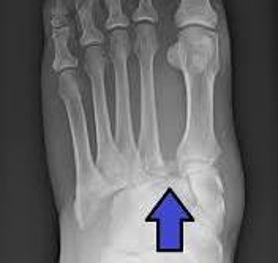
Substantial gap and bony fragments between the first and the second metatarsal base, Lisfranc injury a lateral dislocation of the lesser metatarsals with fractures. It is what we will call a “homolateral” dislocation of the tarsometatarsal joints on weightbearing films.
Such injury requires stabilization and accurate reduction with internal fixation. If it is missed and untreated, the individual may never be able to ambulate properly, and the foot may remain deformed. I like to approach such injuries early because any late reconstruction may become more difficult on a neglected injury. Ligaments may be also involved. A fusion may also be necessary in many cases.
The Lisfranc Joint is part of the middle region of the foot where a group of little bones forms an arch on the top of the foot and meets the metatarsals and extends to the toes. The bones are held in place with strong ligaments assuring a connection between the mid-foot and the forefoot. This complex of ligament, which was described by Lisfranc, bears his name but there is no connective tissue holding the first metatarsal to the second metatarsal. This may represent a weakness in this area placing at risk the tarsometatarsal area forcing fractures and dislocations.

Divergent and convergent injuries
There is little motion at this portion of the forefoot although, it is a joint playing an important role in stabilizing the arch, especially in the push-up, during the walking phase of the gait. Midfoot transfers then the forces generated from the calf to the front of the foot and instability can result when the foot collapses or when the foot loses the support of the arch. Often, degenerative arthritis will follow such injury. A fusion of the joint can become necessary. If you are a smoker or suffer from diabetes mellitus, you may be prone to develop further symptoms of osteoporosis. With that, there are possibilities that the bones fail to heal or might require surgical treatment.

Lisfranc injury with abnormal widening on weight bearing films and stabilization with a plate and fusion.
The Lisfranc joint involves bones and ligaments in the mid-foot and one or many tarsometatarsal joints may be involved. A simple Lisfranc injury can be mistaken for a sprain, especially if it follows a simple sprain, or a fall and even a straightforward twist. One must know that even a simple Lisfranc injury must be considered seriously because it may require many months to heal and still may require surgical treatment.

AO Picture used for hardware fixation
Complex injuries may involve many joints and ligaments, with widening between the first and the second metatarsals and possible fractures of the metatarsals especially the second one and fractures of some tarsal bones like the cuneiform or the cuboid. Such injury tends to damage the cartilage of the small joints which may result later in midfoot degenerative arthritis and further collapse of the arch. Then, complex surgery may be needed to restore stability, provide correction and complete reconstruction of the arch but even when a successful reconstruction is obtained, degenerative arthritis will settle with time...
The plates and screws used to secure the joints will need removal, once they have served their purpose, in securing proper fusion or healing, around six months following surgical treatment. A period of rehabilitation with progressive weightbearing will enhance a return to full activities. The goal in recovery shoots at a pain-free return to all previous activities but sometimes, one can develop chronic pain and discomfort.
Maxime J-M Coles MD
Boca Raton FL
Références :
1- Cassebaum WH/ Lisfranc fracture -dislocation. Clin Orthop Relat Res. 1963 ;30 :116-129.
2- Chen J, Sagoo N, Panchbhavi VK: a literature review of the anatomy, etiology, evaluation and management. Foot Ankle Spec. 2021;14(5):458-67.
3- Stole AH, Hvaal KH, Enger M, Brogger H, Ellingsen Husebye E. Lisfranc Injures: Incidence, mechanisms of Injury and predictors of instability. Foot and Ankle Surg. 2020; 26(5):535-40.
4- Philbin T, Rosenberg G, Sferra JJ. Complications of missed or untreated Lisfranc injuries. Foot and Ankle Clin. 2003. 8(1): 61-71.
5- Lewis JS, Anderson RB. Lisfranc injuries in the athlete. Foot Ankle Int. 2016;37(12):1374-80.

FBA : fondamental black Américain
UN NOUVEAU MOUVEMENT OU COURANT DE PENSÉE
(NOIR AMÉRICAIN) : TRÈS HOSTILE AUX IMMIGRANTS ET AUX HAÏTIENS.
Beaucoup peuvent ne pas savoir ce qu’est FBA. Puisqu’il s’agit d’un mouvement assez récent et ayant connu ses premiers vagissements sous le premier mandat de l’actuel président américain. Avec le nombre impressionnant de noirs américains qui ont déserté le parti démocrate et ont voté républicain lors des dernières élections, le mouvement semble reluire de plus bel depuis le début de la présente administration.
Moi non plus, jusqu’à date récente, je n’en avais jamais entendu parler.
C’est en surfant ou en naviguant sur le web quelque deux ou trois semaines de cela que j’en ai pris connaissance pour la première fois.
Il s’agit en fait, d’une nouvelle idéologie prônée par un groupe de jeunes noirs américains selon laquelle, ils n’auraient aucun lien de sang ni avec les noirs et mulattoes de la caraïbe, ni avec les autres noirs d’ascendance afro-centrique venus des divers pays d’Afrique, ni avec le continent Africain lui-même. Ils se réclament d’être les seuls vrais noirs des états unis. Ils opinent que ce pays fut bâti de leur sang et de leur sueur, et que nulle autre ethnie noire ne devrait prétendre être leurs égaux en droits ou en privilèges. Ces privilèges, continuent-ils, leur appartiennent en toute exclusivité. Ils réclament aussi réparation pour les années de servitude et d’esclavage qu’avaient endurées leurs ancêtres depuis leur débarquement en Amérique au tout début du 16e siècle. Bref c’est une idéologie basée sur la supériorité de leur groupe, sur l’exclusion des autres noirs et sur des réparations pour les torts causés à leur préjudice.
Analysons ces points forts de leur idéologie l’un après l’autre et tentons aussi de comprendre ce qui sous-tend une telle démarche.
D’abord la supériorité de leur groupe en tant que noirs fondamentalement américains. J’ai toujours cru que les peuples et les hommes naissent tous avec des potentiels naturels égaux et qu’ils peuvent exceller ou échouer en fonction des outils qu’ils ont à leur disposition pour avancer dans la vie. La condition des noirs américains n’a jamais été des plus enviables. Et cela se comprend car ils ont travaillé pour d’autres groupes sociaux pendant près de quatre siècles sans avoir jamais été l’objet d’aucune compensation. Ils sont donc sortis de la servitude sans rien pour prospérer et avancer dans la vie. Il leur avait été promis une mule et 40 hectares de terre à leur libération (spécial Field ordre #15 du Secrétariat de la guerre) mais cette promesse n’avait jamais été tenue.
C’était comme libérer quelqu’un de prison après vingt-cinq ou trente ans de détention tout en espérant qu’il aille se faire une vie normale dans un monde qui n’est plus le sien, ni tel qu’il l’avait laissé avant son incarcération. Leur situation n’est au fait guère différent de celle du paysan haïtien toujours confiné dans des lopins de terre qu’ils cultivent au bénéfice des latifundia ou grands propriétaires terriens, sans jamais en devenir les vrais maîtres. Mais en plus de cela, même avec la fin de l’esclavage corporelle, l’esclavage mental a subsisté en eux.
Un exemple : Quand je rentrais en tournée médicale avec un neuro chirurgien noir bien mis dans son costume dans la chambre d’un patient noir dont on discutait le cas et sur lequel on allait intervenir le lendemain, il demanda au neurochirurgien s’il était là pour assurer son transport ? Il ne s’imaginait guère qu’un neurochirurgien noir pouvait avoir à opérer sur lui.
Ils n’ont pas appris à avoir confiance dans la potentialité de l’homme noir, leur semblable. C’est la société Manichéenne américaine qui les a rendus ainsi.
Économiquement parlant, en raison de leur manque de qualification, Ils ont été soumis aux aléas du marché de l’emploi au même titre que les autres groupes ethniques qui forment la classe prolétarienne de la société américaine. Réduits pour la plupart à travailler pour les autres et à vivre d’emplois incertains, sporadiques; et de surcroît peu entraînés pour les jobs high-tech ou intellectuellement aiguillés, ils se sont retrouvés à rivaliser avec d’autres groupes qui recherchent ces mêmes emplois.
Comme ils sont les plus anciens d’entre ces groupes à bas revenus dans un monde en constant changement, il y a carrément des emplois comme dans l’hôtellerie, l’agriculture, et le transport en commun qu’ils ne veulent prendre ou accepter par pudeur ou par réminiscence de leur passé d’esclaves ou de serviteurs.
Cependant, quand les autres groupes acceptent ces mêmes emplois pour survivre, les noirs américains les ont toujours accusés de voler ce qui aurait dû leur revenir de droit, ou encore de travailler à moindre coût à leurs dépens.
Cela a toujours été une source de jalousie, de discorde et de friction larvaire entre les noirs américains et les autres communautés formant l’ossature de la société . L’autre pomme de discorde entre les noirs américains et les autres groupes réside dans le fait que les autres ethnies ont toujours fini par laisser le ghetto et par se déplacer vers les banlieues alors qu’eux -mêmes, ils semblent être condamnés à mourir là où ils sont nés sans aucun progrès significatif.
Ils ont accusé souvent les migrants de se croire meilleurs. Mais il faut le dire clairement que les autres groupes n’ont pas toujours trouvé en eux des modèles à émuler. À mesure que l’on gravit les échelons, les tensions sociales sont moins perceptibles au sein de ces divers groupes.
Comment donc les noirs auraient-ils pu créer de la richesse dans des conditions pareilles ? Ils n’ont aucun moyen pour garder l’argent qui arrive dans la communauté. En fait, une étude a prouvé que l’argent reçu en fin de semaine ou de mois en mois reste pendant seulement quatre heures dans les foyers noirs américains avant de fuir vers une autre communauté.
Il faut dire qu’Ils ont bien essayé de construire leur propre communauté, leur propre “black Wall Streets” mais on connaît bien la suite lorsqu’un terrible incendie criminel avait réduit leurs entreprises à néant. Et cela n’est qu’un exemple parmi tant d’autres.
Certains des promoteurs du mouvement se disent être des noirs pur-sang, et que les autres noirs Afro caraïbéens sont des sangs mêlés. Comment sont-ils capables de déterminer qui est du sang pur ou qui ne l’est pas ? Connaissent-ils le pourcentage de croisements interraciaux entre noirs américains et blancs ? Personne n’est en mesure de l’affirmer. On sait que beaucoup de cousins ne se sont jamais parlé malgré une ascendance commune lorsque la lignée blanche s’estompait sur une liaison interraciale, et qu’elle voulait occulter l’autre lignée à épiderme coloré.
Que dire des noirs qui ont toujours migré des autres iles ou territoires adjacents à la grande terre et qui ont dû garder leur identité propre en raison de leurs difficultés d’assimilation à la culture noire américaine souvent hétéroclite et insaisissable. ?
Que dire des esclaves noirs américains qui ont combattu des deux côtés dans la guerre de Sécession ou d’autres esclaves venus de l’actuel Haïti, et qui ont rendu aux anciens esclaves noirs de toujours leur liberté à Savannah, en Géorgie ?
D’ailleurs, certains noirs possédaient eux aussi des esclaves (<1%.). Cela les bannit-il de la notion de “Fundamental black Américain” dont certains d’entre eux se réclament aujourd’hui ?
La notion “de noirs américains fondamentaux“ est un concept assez flou. Mais il a existé aussi entre les blancs où les Anglais se sont crus être les seuls à devoir jouir de tous les privilèges de la société américaine. C’était exactement ce que le (WASPM) White Anglo-saxon Protestant Male représentait pendant des siècles. La démarche des Allemands, avec Hitler, participait de cette même théorie ou mythe d’être les descendants d’une ligne arienne blanche pure, et qui avait fini par donner naissance au nazisme. Mais les noirs n’ont pas grand-chose à prouver en énonçant cette théorie.
Je ne trouve guère en quoi leur présence en Amérique avant les autres groupes fait d’eux les vrais noirs authentiques des EUA. Ni comment cela les rend supérieurs aux autres noirs ? Car toute lutte de classe sociale est avant tout une lutte économique.
Force est de reconnaître que les premiers noirs ont commencé à arriver aux EUA à partir de 1519. Ils étaient constitués en grande majorité de gens qui avaient été vendus comme esclaves et avaient été forcés de traverser l’Atlantique pour venir Vivre en abrutis aux États-Unis, dans les Caraïbes et partout dans les Amériques. Le bateau déposait une partie de la marchandise humaine à Haïti, à la Jamaïque, à Cuba, ect, et une grande partie de la cargaison aboutissait aux états unis et au Brésil ect.
En conclusion, il n’y a rien d’anormal qu’un groupe donné soit en quête d’une certaine identité et cherche à puiser dans son passé pour embrasser son destin.
Beaucoup d’autres peuples l’ont fait d’ailleurs. Et le mouvement indigéniste des années trente quarante voire cinquante en Haïti, était construit sur un modèle pareil. Je ne comprends pas, cependant, leur haine, leur envie, leur jalousie par rapport aux autres noirs Afro-Caribéens avec lesquels ils auraient intérêt à s’unir dans la recherche d’un idéal commun. Les grands médias sont en partie, responsables. Car, même si le lynchage corporel a en partie disparu en Amérique, le lynchage intellectuel et mental lui, subsiste encore dans ce pays. La quantité de noirs Haïtiens ou des autres groupes ethniques noirs est seulement, estimée à 0.33% de la population des États-Unis. Mais encore crie-t-on “Haro sur le baudet”. Ils se sont laissé manipuler pour faire donc le jeu de ceux qui ont un certain intérêt à les voir s’entre-déchirer.
Ce qui est souvent dangereux dans de tels mouvements c’est lorsqu’on cherche à nier tout ce qui a été construit avant son temps pour aller verser dans une autarcie intellectuelle à l‘issue incertaine voire contreproductive. Ces mouvements sont souvent de durée limitée ; et rares sont ceux d’entre eux à ne pas avoir donné dans le panneau. Ils finissent toujours par cracher sur eux-mêmes et par se salir le visage en tentant de cracher sur les autres…
Pour finir, certains ont comparé récemment Haïti à Gaza et la république Dominicaine à Israël. Malheureusement on ne prend jamais conscience de nos laideurs. Et nous sommes toujours là à attendre les miettes qui tombent de la table des grands. Nous avons besoin de prendre conscience de notre échec en tant que Nation et de tirer les conséquences de nos inconséquences. Nous ne pouvons pas tous abandonner notre pays et demander aux autres de prendre soin de nous, et de nous respecter. Il est temps que cela finisse…
Rony Jean-Mary, M.D
Coral Springs, Florida.
Le 26 Juillet 2026
REFERENCES:
1- Wikipedia: Slavery and the Culture of America beyond 1619
2- Library of Congress (Gov.): GPB GA Studies and first Africans known to visit North America mainland (1526).
3- NJ State Library: Immigration and Relocation in US History in early 1500.

The Goose and the Gander
When he was single, Henri Daniel, better known as HD, had moved easily through the cloak-and-dagger world, the epicurean milieu, and every permutation between the two. Yet one chance encounter stood above the rest because it altered his perspective, sharpened his political awareness, and tested the limits of his personal code. He did not expect such a reckoning when he accepted an offer to do lucrative consulting work in Kenya, a country that carried pleasant memories from his fifteen years there under Agency cover as a USAID field agent. His assignment then had been to monitor Chinese penetration of the largest seaport on the East Coast of Africa, located in the territory of an important ally. As a Yankee raised in New England by affluent mixed-race parents, he could not have imagined a setting more different from the familiar world he had left behind.
Far from the dull third-world place he had vaguely imagined, Kenya turned out to be vibrant and layered. HD, ever curious, relished exploration. Nairobi, the capital, was his first stop. The locals proudly pointed out the national park within the city limits, where wild animals could be seen in their natural habitat. Whenever he went there, he found himself gazing at the giraffes’ long necks, the zebras’ stripes, and the gracefulness of the impalas. HD the bachelor also enjoyed the social scene. In Nairobi, his revelries ranged from cosmopolitan cuisine to rooftop parties and clubs. HD the architecture critic admired the city landscape. Its clean, sprawling modernity and skyscrapers with sinewy curves jutting into the air filled him with admiration. The city’s highland location added an unexpected bonus: cool, humidity-free weather.
His real destination, in the coastal lowlands, contrasted sharply with Nairobi. Instead of a soothing, mild climate, Mombasa greeted him with heat and humidity. Located on an island to the southeast facing the Indian Ocean, the city beckoned visitors to pristine beaches washed by calm, turquoise water. HD, the history buff, quickly took a great liking to it.
Mombasa sat at a crossroads of civilizations. To its south lay Zanzibar, the spice-island archipelago renowned for its historical past; to its north stretched the Horn of Africa and, beyond it, the Arabian Peninsula. Such geography made the city strategically valuable, drawing powers that sought hegemony or influence and making it an ideal venue for sleuthing. Whereas Nairobi impressed HD with sleek buildings, efficient highways, and modern transportation, Mombasa claimed a slower-paced niche: a small coastal town where a proud past rubbed shoulders with a modern touch. That mixture appealed to him, shaped as he was by New England’s habit of preserving the old while accommodating the new. Beyond its strategic importance, Mombasa attracted civilians from every corner of the globe. Without fuss or fanfare, it had become a quaint relocation spot for expatriates working remotely and a guarded secret for retirees seeking a low-cost but suitable alternative. There, HD saw how technology had turned the world into a global village. People drawn by the bouquet of other cultures and customs intermingled peacefully. Places once associated with the heinous slave trade now seemed capable of voluntary, equitable exchange and human bonding among different ethnic groups.
That memory of Mombasa as a place of peaceful mingling made the new allegation more jarring. If the city’s cosmopolitan charm had concealed a renewed traffic in human bodies, then HD’s assignment was no longer merely a business opportunity. It was a test of whether his talent for operating in compromised worlds had finally met a compromise he could not accept.
HD remembered being impressed by the relative comity among the different groups living on that piece of land, so he was surprised to read about post-election strife. The offer to do PR work and lobbying for investors with a hotel chain in Kenya intrigued him. His antennae went into overdrive, and he wondered whether the offer was too good to be free of stains. Due diligence meant flying to the location and obtaining first-hand evidence. On the plane from New York City to Nairobi, HD heard a disturbing BBC podcast titled “Human Trafficking: Fact or Fiction?” As he sat listening, an ominous phrase opened the exposé: “It would be naïve to assume that an old traffic in human beings disappears simply because the market changes shape. Wherever the profit remains large enough, criminal networks adapt. In Asia, sex workers are bought and sold. In Europe and Africa, criminal elements do the same. Lately, disturbing reports suggest that Mombasa may also be involved. Young women from Somalia, Eritrea, and Ethiopia are surfacing with alarming frequency among the massage parlors on the island, victims of sex trafficking.”
The narrator’s voice had a lilting French accent. HD recognized it again when he landed in Nairobi and saw the same man on a television panel debating the issue. The speaker was an avuncular fellow with sideburns and a receding hairline. His smooth, permanent tan had the polished appeal of aniline-coated top-grain leather. The caption identified him as Lucner Valoir, a retired UN career employee. One response caught HD’s attention: “Criminal elements start with one type of illegal business and then graduate to ever more lucrative ones. Sex trafficking, sooner or later, will veer into drug trafficking, arms smuggling, and all the harmful consequences to society.” People did not need to be reminded of the havoc this could cause. Somalia, a stone’s throw away, was the poster child of chaos. HD knew a corker when he heard one, and this observation had the look and feel of one. He wanted to know more about this fellow. Valoir had the gravitas of a seasoned professional and likely possessed useful information. The possibility that the investors had a link to this shady business needed to be ironed out. No pay would entice HD to risk his integrity or reputation by becoming involved with anyone connected to human trafficking. That was what his conscience told him. Another voice within him objected that it would be hypocritical to strike a puritanical posture after spending his adult career rubbing shoulders with an underground world peopled by tainted individuals. Were the madams who handled call girls so different from the runners of these massage parlors? Those seeking a service and willing to pay for it expressed a consumer choice. Whenever there was demand, people would be willing and able to supply it. It was commerce, as old as the world. Trying to stem it, that inner voice insisted, was a fool’s errand.
HD was no saint. By profession, he trafficked in influence, using unorthodox methods whenever a task required them. Still, his father’s lineage carried the memory of the Middle Passage, and the idea of buying and selling a human being struck a chord that could erupt with an intensity beyond his control. Here, then, was the conflict he had avoided naming: HD the fixer versus HD the descendant of slaves. How could he square his moral upbringing with the lax standards he tolerated in his work? Faced with that conundrum, HD resorted to his toolbox. He looked up Lucner Valoir and found a surprising profile: Haitian, of patrician pedigree like himself, with several middle names—Roland Pierre-Marie Barthélemy Astor. Valoir, nicknamed Merlot for his fondness for the wine, had spent his life in UN service. His record showed a stellar career, no known stain, no association with shady groups or movements, and no complaints about his integrity. He was in Kenya to raise awareness about this modern version of the slave trade.
HD sent Merlot an email inviting him to lunch so they could discuss the matter further. They fixed a date for the following day. HD considered bringing a bottle of Merlot, then thought better of it; he was not supposed to know the man’s fondness for the wine yet. Through these two men, two worlds were meeting. One came from a mindset of what should be done; the other had been trained to focus on what could be done. Merlot’s world asked whether an action was sound. HD’s ecosystem prized results, preferably achieved in stealth mode. The lunch took place a little after noon. When they met, each sized up the other. Merlot saw a man in his prime, late thirties, lithe, preppy-clad, lighter in complexion and much taller, and wondered whether HD was all polished cover and hollow content. HD noticed that Mr. Valoir carried himself with the gravity of a man accustomed to being heard. “Bonjour, Monsieur Valoir.” HD bowed his head in deference to a senior as they shook hands. After the formalities, he went straight to the point. “I am very interested in this issue of human trafficking in this area. Is this a new phenomenon?” Both ordered baobab juice. Merlot cleared his throat, a sure sign he was about to engage a topic dear to his heart. “Within a fifty-mile radius of Mombasa, one would be at the epicenter of human trafficking going back centuries. The sultans of Zanzibar, to its south, were famous for sending hordes of Africans to the Arabs as slaves. You and I are descendants of such practice on the West Coast of Africa, since we live in the New World and are very sensitive to this shameful practice. In a sense, that habit has been very difficult to die. To this day, it exists in a more subtle form, but the end result is no different. My colleagues who work at UN refugee camps in various areas tell me stories that can make one retch. Young women are lured to work with the promise of better pay, only to become sex slaves. Would you like your sister to go through this? Lately, due to the upheaval up and down the Horn of Africa, such activities have increased. They bring them to big cities, resort towns, wherever there is a transient population and a high demand for prostitutes. Hotel operators are aware of it, but turn a blind eye. Same with government officials. One can only surmise they get money under the table to pretend such activities are not taking place. Let’s be clear: women entering the oldest profession is not the issue here. I am not condemning people who do it. However, forcing one to do it under threat of one’s life is not acceptable.”
HD, who had had his share of prostitutes, had never once wondered whether they were sex slaves. Merlot provided him with an earful of information and a bagful of worries. “What would you like to see done?” HD asked in a half-serious, half-quizzical manner because the matter had not yet settled in. Merlot ordered a glass of Merlot and was primed to provide a consequential answer. “I always say that what is good for the goose should be likewise for the gander. As in Holland, prostitution should be legalized and regulated. It ought to be a choice, and because there are public health issues, there should be safeguards to prevent the spread of sexually transmitted diseases. By making the trade legal for consenting adults, society would undercut underground recruitment and the buying and selling of women. Safety first. At the same time, unless human trafficking carries stiff penalties, the practice will flourish so long as large profits can be made.”
“What brings you to this neck of the woods?” Merlot asked casually, pretending he had no background data on the young chap. His review of HD’s past had made him suspicious. USAID work could, not infrequently, serve as a cover for intelligence work. HD never discussed his previous stint at the Agency with others; that was forbidden, or, in his lingo, verboten. He sensed that Merlot could see through him, so he offered only what was necessary. “In my previous career, I worked for USAID, helping entrepreneurs get started in the IT sector. As I’m sure you know, Kenya produces quite a few talented folks in this field. Now I’m focusing on PR gigs. I am considering an offer from Obikpo Associates, LLC. They’re involved in the hotel business, and I am here on a fact-finding mission.” “Well, putting two and two together, you’re worried they might be involved in some way with human trafficking, right?” The question landed before HD could raise a shield. Strange, since he was known for noticing nuances in people’s behavior and picking up subtleties with ease. For once, he was on the receiving end. He usually played the calculating strategist. Now he saw a chance to make good money, only to hit a moral speed bump: a commission that might be stained by slave trading. As if on cue, Merlot added, “I see you’re having an internal debate. You can flip the situation. These businessmen probably benefit from these girls. Knowing how the entertainment industry works, their clients bring them to their rooms, and some of these clients probably know about the girls’ existence. The problem is that many are coerced into doing this, which is wrong. Humans are not cattle and shouldn’t be treated as such. Here’s an idea: why not suggest they change the system and create an official red-light district for willing women who choose this work, similar to the Dutch model? You could say it’s good PR and would help fight human trafficking while earning kudos!” For once, HD felt checkmated.
It was a clever idea, but HD suspected it would be dead on arrival. He could already hear the response: “This is a solution for what problem?” Rocking the boat would step on too many toes and erase too many bribes. Yet HD knew better than to reject the proposition flat-out; that would insult a bona fide advocate for a good cause. Besides, some kinship bound him to Merlot on this matter. The idea of making money while others were enslaved to enrich a third party rubbed him the wrong way. He still had the option of seeing no evil and hearing no evil, but he knew he could not erase the stench that would cling to him or lift the guilt that would settle on his chest and follow him long after the deal was done. In that sense, HD was grateful for the encounter. It revealed moral limits he had ignored in the past, limits that had been there all along. As these conflicting ideas danced in his head, he finally found a sensible response. “You and I know the chances of moving the needle this way are remote. There is no critical mass of protest from members of society against this. Politicians will not respond because they are not paying a price for maintaining the status quo. On the other hand, it’s a good idea to keep talking about it and remind people of the negative publicity this could attract among the African diaspora, since there is a historical stain of the Middle Passage on the West Coast and Zanzibar as a departure point on the East Coast. I can even help you get an essay on this matter published in a major newspaper back in the States. What say you?”
Merlot realized he was not facing a lightweight. They continued talking, and, of course, Merlot had quite a few glasses of his namesake wine. “My friends call me Merlot because of my fondness for this wine. No need to call me Monsieur Valoir. Merlot will do.” They agreed to stay in touch, and Merlot would indeed write an essay on the subject. HD would cash in an IOU to get it published.
With Merlot’s challenge still needling him, HD walked into the Obikpo meeting prepared to listen for more than polished assurances. The question was no longer whether the investors had a convincing public-relations problem. It was whether their denial could survive the moral pressure Merlot had placed on the table.
HD did meet with the managing partner of Obikpo Associates. “Mr. Daniel, I hope you can help with this avalanche of bad news. We have been fielding calls from the press since this newscast about sex slaves. I feel incensed because we are presumed guilty until proven innocent. We have some of the most pristine beaches in the world, and we want visitors. Anything wrong with that? That is the reason why we want good PR. France’s Côte d’Azur and Mexico’s Playacar are known around the world. Why can’t we be? If some ragtag criminals are involved in whatever they are involved in, that is not a reflection on us. People visit the United States, and you folks have the mafia there also. Does that stop visitors? No. What works for the goose can also work for the gander. I am sick and tired of this nonsense about sex slaves. We have no need for that. We can make a decent buck without that stain on it.” HD felt relieved, but not absolved. The story about sex slaves eventually died down because it was not as large as feared, yet Merlot and HD stayed in touch. Merlot wrote an essay for the Washington Post about the subjugation of women and the dirty business of trafficking human flesh, and HD used his influence to help it find a national audience.
Reynald Altéma, MD
Palm City FL


Metabolic Syndrome and Immunotherapy
A Converging Picture of Cardiometabolic-Immune Health
Cardiology, endocrinology, and oncology have historically operated as separate silos. Over the past few years however, a growing body of evidence has forced these fields together around a single theme: metabolic syndrome. Metabolic dysfunction, chronic inflammation, and immune activity are deeply intertwined, and risk prediction tools are finally starting to reflect that reality. The orchestra that is medicine, under the leadership of the primary care physician as a conductor, uses elements (the sounds) from the specialists to deliver patient-centered care in a harmonious way with outcomes resembling the Tocceta and Fugue in D minor by Johann Sebastian Bach. Alternatively, in the event the specialists revert to singularism, the patient is non-compliant or access to healthcare is interrupted, the cacophony that ensues can be fatal. This article covers three connected topics — metabolic syndrome, its relationship to immunotherapy, and the American Heart Association's PREVENT equations and current ASCVD treatment protocol to guide a more succinct primary care practice .
1. Metabolic Syndrome: The Basics
Metabolic syndrome (MetS) is a cluster of interrelated conditions that together raise the risk of atherosclerotic cardiovascular disease (ASCVD), type 2 diabetes, and all-cause mortality. A person is generally diagnosed with MetS when they have at least three of the following five criteria:
• Abdominal obesity — elevated waist circumference, with thresholds varying by population
• Elevated triglycerides — ≥150 mg/dL, or on treatment for it
• Low HDL cholesterol — <40 mg/dL in men, <50 mg/dL in women
• Elevated blood pressure — ≥130/85 mmHg, or on antihypertensive therapy
• Elevated fasting glucose — ≥100 mg/dL, or on treatment for hyperglycemia
MetS affects roughly a third of adults in the United States, with prevalence rising alongside obesity rates. Its core pathophysiology centers on insulin resistance and visceral adiposity, which drive a state of chronic, low-grade inflammation. Adipose tissue in MetS behaves almost like an endocrine and immune organ: it secretes pro-inflammatory cytokines (TNF-alpha, IL-6, IL-1beta), activates inflammasome pathways, and recruits immune cells such as macrophages into fat tissue.1,2 This inflammatory state is now understood to be a central mechanistic driver connecting MetS to both cardiovascular disease and altered immune function.1,2
In late 2023, the American Heart Association proposed folding this concept into a broader diagnostic framework called Cardiovascular-Kidney-Metabolic (CKM) syndrome, staged from 0 (no risk factors) to 4 (clinical cardiovascular disease with kidney or metabolic dysfunction).3,4 This reflects growing recognition that metabolic, renal, and cardiovascular health cannot be assessed in isolation.
2. The Metabolic-Immune Connection and Immunotherapy
The chronic inflammation seen in MetS doesn't stay confined to blood vessels and fat tissue — it reshapes systemic immune function, and this has real implications for immunotherapy, particularly cancer immunotherapy using immune checkpoint inhibitors (ICIs) such as PD-1/PD-L1 and CTLA-4 blockers.
Mixed but notable associations with outcomes. One recent institutional registry study categorized patients as having metabolic syndrome if they met at least three of five criteria — hypertension, obesity, elevated HbA1c, low HDL, or elevated triglycerides — at the time immune checkpoint inhibitor therapy began, and examined how this related to treatment outcomes.5 Separately, other work has found that metabolic syndrome is associated with improved overall survival on first-line checkpoint inhibitor therapy in non-small cell lung cancer, a somewhat counterintuitive finding attributed to the heightened baseline inflammatory and immune activation state in MetS patients, which may prime a more robust anti-tumor immune response.6
Immune-related adverse events (irAEs). The flip side of that heightened immune activity is risk. Despite years of experience with checkpoint inhibitors, immune-related adverse events remain largely unpredictable, and researchers have specifically investigated weight and metabolic disease as potential predictors, though findings across studies have been mixed.5,7 The underlying biological plausibility is straightforward: MetS creates a pro-inflammatory baseline (elevated cytokines, altered T-cell populations), and checkpoint inhibitors work precisely by releasing the brakes on immune activation — so a patient who starts from a higher inflammatory baseline may be more prone to autoimmune-like toxicity once those brakes come off.5
Beyond cancer immunotherapy. The metabolic-immune relationship runs in both directions and extends past oncology:
• Chronic infections and metabolic disease appear to influence each other bidirectionally, with inflammatory and immune pathways implicated in both the development and complications of diabetes and metabolic syndrome.8
• Sepsis-driven metabolic reprogramming can suppress anti-tumor immunity and reduce the effectiveness of cancer immunotherapy, illustrating how acute metabolic stress can blunt immune treatments.9
• Metabolic syndrome after organ transplantation has been shown to sustain immune system activation and chronic inflammatory burden, worsening long-term graft and patient outcomes.10
• Inflammasome pathways (e.g., NLRP3) are increasingly viewed as therapeutic targets in MetS itself, with several existing and investigational drugs working specifically by dampening this inflammatory-immune circuit.2
• Systemic inflammation is increasingly recognized as a prognostic marker across the broader cardiovascular-kidney-metabolic syndrome spectrum.11
• The clinical takeaway is that metabolic health is no longer a background variable in immunotherapy — it's an active modifier of both efficacy and toxicity, and it's likely to become part of pre-treatment risk stratification as more data accumulates.
3. The PREVENT ASCVD Guidelines
Cardiovascular risk calculators are the clinical bridge between metabolic risk factors and treatment decisions (statins, blood pressure medication, lifestyle counseling/health literacy). For over a decade, the standard tool was the 2013 ACC/AHA Pooled Cohort Equations (PCE). In November 2023, the American Heart Association published a replacement: the PREVENT (Predicting Risk of cardiovascular disease EVENTs) equations.12,13
What changed:
• Broader outcomes. PREVENT estimates 10- and 30-year risk for total cardiovascular disease, ASCVD specifically, and heart failure — the older PCE only estimated ASCVD risk.13,14
• Kidney and metabolic integration. PREVENT incorporates kidney and metabolic health measures such as BMI and estimated glomerular filtration rate (eGFR), reflecting the CKM framework described above; optional inputs include urine albumin, HbA1c, and a social deprivation index.14
• Removal of race as a variable. Unlike the PCE, PREVENT does not use race in its calculations, instead relying on measures like geographic deprivation.3,12
• Younger age range and longer horizon. PREVENT applies to adults aged 30–79 and offers 30-year risk estimates in addition to the traditional 10-year window.15,13
• Larger, more representative derivation cohort. The AHA PREVENT calculator was built using data from over 6.6 million patients collected from 1992 to 2017, a substantially larger dataset than the cohorts underlying the original PCE.3
How risk translates to treatment. Under current guidance built around PREVENT:
• Lipid-lowering therapy is generally recommended once 10-year ASCVD risk reaches roughly 3% or higher, refined by risk-enhancing factors and shared decision-making.12,15
• For blood pressure management, treatment is generally recommended when 10-year total CVD risk is 7.5% or higher, or when the patient already has clinical cardiovascular disease, diabetes, or chronic kidney disease.12
• The 30-year risk estimate supports statin consideration in younger adults (30–59) with LDL-C 160–189 mg/dL when 30-year ASCVD risk is ≥10%, even if 10-year risk looks unremarkable.15,13
• Regardless of calculated risk score, guidelines emphasize managing modifiable risk factors and periodically reassessing risk over time.12
PREVENT and the older Pooled Cohort Equations don't always agree, and clinicians currently have access to both through tools like the ACC's CVD Risk Estimator Plus.14,13 PREVENT tends to estimate somewhat lower risk than the PCE in many populations and transitioning between the two has real implications for how many patients cross treatment thresholds — a topic still being actively studied.15
4. The New ASCVD Treatment Protocol: 2026 ACC/AHA Dyslipidemia Guideline
In March 2026, the ACC and AHA (with ten co-sponsoring societies) published a full replacement for the 2018 blood cholesterol guideline, retitled the Guideline on the Management of Dyslipidemia to reflect a broader focus beyond LDL alone — triglycerides, remnant particles, and lipoprotein(a) are now formally part of the treatment framework.16,17,18 It builds directly on PREVENT, turning risk scores into a concrete treatment protocol.
The "CPR" framework
The guideline organizes clinical decision-making into three steps:19,20
• Calculate — 10- and 30-year ASCVD risk using the PREVENT equations.
• Personalize — adjust that estimate using risk enhancers not captured by PREVENT itself: family history of premature ASCVD, chronic inflammatory disease, elevated Lp(a) or hs-CRP, and a newly formalized set of reproductive risk markers (preeclampsia, gestational hypertension or diabetes, preterm delivery, premature/early menopause, or PCOS).
• Reclassify (and reassess) for patients near a treatment threshold, use a coronary artery calcium (CAC) score to refine the decision. CAC scoring was upgraded from a “consider” (2a) to a firm (Class 1) recommendation.
Return of absolute LDL-C targets
The guideline moves away from the 2018 approach of percent-reduction targets and reinstates concrete numeric goals:18,19
Risk category (10-yr PREVENT ASCVD risk) | LDL-C goal | Non-HDL-C goal |
High risk (≥10%) | <70 mg/dL | <100 mg/dL |
Intermediate (5–10%) or borderline (3–5%) | <100 mg/dL | <130 mg/dL |
Established ASCVD | <70 mg/dL | — |
Very-high-risk ASCVD* | <55 mg/dL | — |
*Very-high-risk ASCVD = ≥2 major events (recent ACS, prior MI, ischemic stroke, symptomatic PAD) or 1 major event plus ≥2 high-risk features (age ≥65, prior revascularization, current smoking, diabetes, heart failure, hypertension, or LDL-C ≥100 despite maximally tolerated statin plus ezetimibe).19
What's newly built into the protocol
• Universal Lp(a) screening. Every adult should have Lp(a) measured at least once in their life; elevated Lp(a) now independently supports earlier preventive therapy regardless of LDL-C.17,18,19
• ApoB as a refinement tool. In patients with ASCVD or high risk, apolipoprotein B better captures the true number of atherogenic particles than LDL-C alone.17,19
• New automatic-treatment populations. Adults aged 40–75 with CKD stage 3 or higher, or with HIV, now qualify for lipid-lowering therapy as primary prevention regardless of calculated LDL-C or PREVENT score.21
• Reproductive risk history matters. A documented history of preeclampsia, gestational diabetes, premature menopause, or PCOS now factors into the personalize/reclassify steps.20
• Triglycerides. Statin therapy remains the primary tool for lowering ASCVD risk in patients with persistent hypertriglyceridemia; triglyceride-specific therapy is reserved largely for pancreatitis prevention at levels ≥1000 mg/dL.18
Practical treatment escalation
For most patients, the medication ladder looks like: high-intensity statin first → add ezetimibe if not at goal → add a PCSK9 inhibitor (monoclonal antibody or the siRNA agent Inclisiran) or bempedoic acid for patients who remain above goal or are statin-intolerant → consider emerging Lp(a)-lowering agents for patients with markedly elevated Lp(a).17,18,19 The guideline's overall framing is to intervene earlier and target lower absolute LDL-C numbers, rather than waiting for a fixed percentage reduction from an unknown baseline.20
Evidence-based patient-centered care is provided within an ecosystem. The thread connecting all three topics is inflammation as a shared currency between metabolic and immune health. Metabolic syndrome sets a pro-inflammatory baseline that shapes how patients respond to immunotherapy — both in terms of anti-tumor efficacy and toxicity risk. Meanwhile, the same kidney-metabolic factors now recognized as central to that inflammatory burden (BMI, eGFR, glycemic control) have been formally built into how we calculate cardiovascular risk through PREVENT, and now into the treatment protocol itself through the 2026 dyslipidemia guideline. The practical implication for clinicians: a patient's metabolic profile is no longer just a cardiovascular risk factor to plug into a calculator — it's increasingly relevant context for immune-based treatment decisions as well.
This article is for general educational purposes and is not a substitute for professional medical advice. Anyone with questions about their personal cardiovascular or metabolic risk, or about cancer treatment options, should speak with their physician.
Darlyne Christy Janvier, MD, DNP, AGPCNP-BC, CNP
Boca Raton FL
References:
1. Sindhu S, Ahmad R. Metabolic inflammation and cellular immunity. Cells. 2023;12(12):1615.
2. Inflammasomes: novel therapeutic targets for metabolic syndrome? Front Endocrinol. 2025;16:1569579.
3. Khan SS, Coresh J, Pencina MJ, et al. Novel prediction equations for absolute risk assessment of total cardiovascular disease incorporating cardiovascular-kidney-metabolic health: a scientific statement from the American Heart Association. Circulation. 2023;148(24):1982-2004.
4. Drug Information Group. What are the features of calculators used to estimate cardiovascular risk? University of Illinois Chicago College of Pharmacy. Published June 2024. Accessed July 8, 2026. https://dig.pharmacy.uic.edu/faqs/2024-2/june-2024-faqs/what-are-the-features-of-calculators-used-to-estimated-cardiovascular-disease-risk/
5. Metabolic syndrome and immune-related adverse events. Cancer Immunol Immunother. 2026;75(1):39.
6. Bou Zerdan M, Ashok Kumar P, Barrios DM, et al. Metabolic syndrome is independently associated with improved overall survival to first-line therapy with immune checkpoint inhibitors in non-small cell lung cancer. Front Oncol. 2023;13:1134824.
7. Leiter A, Carroll E, De Alwis S, et al. Metabolic disease and adverse events from immune checkpoint inhibitors. Eur J Endocrinol. 2021;184(6):857-865.
8. Immunometabolic crossroads: infections as bidirectional modulators in diabetes and metabolic syndromes. Front Endocrinol. 2025.
9. Sepsis-driven metabolic reprogramming shapes cancer immunotherapy efficacy, metastatic potential, and drug sensitivity. Front Immunol. 2025;16:1642477.
10. Novel insights and an updated review of metabolic syndrome in immune-mediated organ transplant rejection. Front Immunol. 2025 ;16 :1580369.
11. Mabhida SE, Mokoena H, Sello MG, et al. Inflammation as a prognostic marker in cardiovascular kidney metabolic syndrome: a systematic review. Int J Mol Sci. 2025;27(1):134.
12. MDCalc. Predicting Risk of Cardiovascular Disease EVENTs (PREVENT) calculator. Accessed July 8, 2026. https://www.mdcalc.com/calc/10491/predicting-risk-cardiovascular-disease-events-prevent
13. ClinCalc. PREVENT ASCVD risk calculator: 10-year risk of cardiovascular events using PREVENT 2023 equations. Accessed July 8, 2026. https://clincalc.com/cardiology/PREVENT/
14. American College of Cardiology. CVD Risk Estimator Plus. Accessed July 8, 2026. https://www.acc.org/tools-and-practice-support/mobile-resources/features/cvd-risk-estimator-plus
15. Statin recommendations among US adults with the 2026 dyslipidemia guidelines. arXiv. Preprint posted 2026.
16. American College of Cardiology. ACC, AHA release new clinical guideline for managing dyslipidemia. Published March 13, 2026. Accessed July 8, 2026.
17. National Lipid Association. 2026 ACC/AHA/Multisociety dyslipidemia guideline released. Published 2026. Accessed July 8, 2026. https://www.lipid.org/nla/2026-accahamultisociety-dyslipidemia-guideline-released
18. Updated 2026 dyslipidemia management guidelines. The Cardiology Advisor. Published 2026. Accessed July 8, 2026.
19. American College of Cardiology/American Heart Association Joint Committee on Clinical Practice Guidelines. 2026 ACC/AHA/AACVPR/ABC/ACPM/ADA/AGS/APhA/ASPC/NLA/PCNA guideline on the management of dyslipidemia. Circulation. 2026.
20. American College of Cardiology. Prioritizing health | Lower sooner: how the 2026 dyslipidemia guideline changes practice. Published July 1, 2026. Accessed July 8, 2026.
21. 2026 Dyslipidemia guideline-at-a-glance. JACC. 2026.
How Empires Turn Taboos into Weapons Every society has things it refuses to touch. This essay grows out of Chapter 7 (“How the Devil First Entered the Pig”) of my independently published book, “Who Put the Devil Into the Pig?” As I stated in the introduction to this chapter: “Many philosophical and religious traditions recognize the concept of a devil as either a personification or a creator of evil. In some religious traditions, unwanted events are considered to be caused by the devil as punishment for evil thoughts or behavior, while in other traditions the devil is itself the cause of unwanted events and bad behavior. Some traditions have several devils, some who cause the bad behavior and others who punish for it, while in some traditions the devil is ultimately simultaneously responsible both for bad conduct as well as punishment…” Some forbidden items are foods. Some are words. Some are gestures, clothes, bodies, animals, rituals, flags, graves, books, or places. The refusal is rarely only practical. A taboo is a boundary drawn around a people’s moral imagination. It tells the group who they are by telling them what they must not do. This is why taboos are politically dangerous. They are not merely prohibitions. They are identity under pressure. A taboo held inside a community can organize belonging. A taboo seized by an enemy can be turned into a weapon. That is what happened to the pig. Long before the pig became associated with the devil in Christian imagination, it had already carried a burden of meaning in Jewish life. The interdiction against pork was not simply a dietary preference. It belonged to a wider religious taxonomy, a way of ordering the world according to purity, distinction, obedience, and communal identity. To abstain from pork was not only to refuse a meat. It was to participate in a worldview. Then the Emperor Antiochus IV understood something every occupier eventually learns: if you want to dominate a people, you do not only attack their armies. You attack the symbols through which they understand themselves. In 167 BCE, during his effort to impose Hellenistic uniformity on Jerusalem, a troublesome part of his kingdom, Antiochus forbade circumcision, placed a statue of Zeus in the Temple, and demanded pig sacrifice there. The act was not random. It was not merely offensive. It was strategic. It used Jewish law against Jews. This was the weaponization of taboo. A pig sacrifice in the Temple was not just the introduction of an unwanted animal into a sacred space. It was an attempt to invert the moral order of a people who the Emperor found troublesome. The thing forbidden was made compulsory. The boundary was not merely crossed; it was trampled in public, by force, under imperial command. That is a particular kind of violence. It does not only destroy property or kill bodies. It seeks to humiliate the moral universe that gives people their coherence. It says: what you hold sacred is subject to our power. What you refuse, we can make you perform. What distinguishes you, we can use to degrade you. This is why symbolic violence can be so enduring. A burned building may be rebuilt. A tax may be repealed. A ruler may die. But humiliation lodged inside a community’s sacred categories can travel for centuries. After Antiochus, the pig was no longer only taboo. It had been politically marked. This matters for governance because symbols are never decorative in struggles over power. They are instruments. They can rally, shame, exclude, terrify, mock, and discipline. They can carry messages more quickly than laws and more deeply than speeches. A flag raised in a conquered city is not cloth. A desecrated shrine is not architecture. A forbidden animal forced into a sacred ritual is not livestock. It is rule by humiliation. We often think of governance as the management of roads, taxes, courts, borders, and offices. But governance also includes the management of meaning. Who gets to define what is pure or polluted? Who decides which practices are legitimate? Who has the power to rename an animal, a ritual, or a people? Who can force a community to participate in its own degradation? Empires understand this well. They rarely seek only obedience. They seek consent, imitation, and surrender at the level of habit. Language, clothing, food, worship, calendars, and names become administrative tools. Cultural domination is efficient because once people internalize the ruler’s order, the sword can rest more often in its sheath. But the danger for the ruler is that symbolic humiliation can also produce resistance. The same act intended to break a community may clarify its boundaries. The taboo becomes sharper. The insult becomes memory. The animal becomes more than an animal. It becomes a sign of occupation, contempt, and defiance. This is one reason the pig’s political history is so revealing. It shows how a species can move from being economically valuable, to religiously forbidden, to culturally reviled, to politically weaponized. The animal itself did not change. The meaning around it did. Meaning is one of humanity’s oldest battlegrounds. A community under domination may not control the army, the tax collector, or the imperial governor. But it can still control memory. It can remember the insult. It can teach children what the insult meant. It can preserve revulsion as identity. It can turn refusal into resistance. I call this “governance from below.” The pig did not become politically powerful because it plotted anything. It became powerful because human beings made it a bearer of moral order, then made it an instrument of domination, then made it a memory of injury. This is the strange fate of symbols. They begin as a natural part of the world and then they become part of the way we govern the world. Antiochus used the pig to say: your law is beneath my authority. The Jewish refusal answered: your authority is beneath our law. That confrontation is much larger than pork. It is about the limits of power. It is about whether an empire can compel not only obedience, but moral participation. It is about whether identity can survive when its symbols are turned against it. The question is still with us. Modern politics is full of weaponized taboos. Communities are mocked through the things they hold sacred. Their words are turned into slurs. Their symbols are inverted. Their rituals are caricatured. Their grief is politicized. Their food, clothing, language, and bodies become sites of struggle. This is why we should take taboos seriously, even when we do not share them. A taboo is not just a superstition waiting to be corrected by outsiders. It is often a social boundary that carries memory, discipline, belonging, and fear. When such a boundary is attacked deliberately, the attack is not incidental. It is governance by desecration. The pig’s story teaches us that power does not only rule through force. It rules through meaning. And sometimes the cruelest conquest is not making people obey. It is making them participate in the violation of what tells them who they are. P.S. References and citations are included in the print version of the book. But as usual, I’ll post a short “Wednesday note” later this week to continue this conversation and invite reader responses.
Winston Salem, NC |

Alexandrins de la Sagesse
Quand vous insultez une personne patiente,
Avec vos paroles blessantes et arrogante
Ces fausses accusations de bouche médisante,
Sont des armes léthales, des balles offensantes.
Songez à l'éclair, à sa force foudroyante
C 'est le calme avant la tempête dévorante
Les nuées surchargées, au-delà de la tourmente,
Survoltées d ' orages, d ' énergies éclatantes
C'est le brusque flash de la lumière aveuglante
Qui précède les cassures perlées et fracassantes,
Dans les nuages en détonations tonitruante
Le ciel s'éffondre en résonances assourdissantes.
Lorsque vous agressez une âme tempérante
Son réseau nerveux mute en rûche bourdonnante
Tout comme le volcan endormi, en attente
Du réveil brutal de ses laves bouillonnantes ,
Explose, poussé par la cause déclenchante
L'amour propre , face à toute attaque outrageante,
Se libère des convenances contraignantes
Lorsque vous agressez une âme tempérante
Quand vos erreurs de jugement sont évidentes
Réhaussées de dix mille expressions révoltantes
Quand vos dires n'évoquent qu' images répugnantes
Vos élucubrations que démarches indignantes;
L' affront génère une vraie violence démente
L' orgueil se déchaîne en furieuse déferlante ,
Balayant tout corps dans sa course galopante.
La gestion des mots à la vertu apaisante
De prévenir la méfiance, d'induire l'entente.
L'écho des mots renvoie la note concordante.
Le ton calme appelle à la réponse clémente.
Fuyez, des vues, la rectitude intransigeante ;
Les idées préconçues, figées, paralysantes,
Les préjugés et leurs méthodes ankylosantes.
Contournez les injures, épines perforantes.
Armez-vous de justifications convaincantes,
De vision large, impartiale, indépendante;
De mesures justes et de l' humeur conciliante.
Cultivez, en vous, l' indulgence bienveillant;
Gardez la distance critique, clairvoyante;
Soyez comme l' eau, souple, louvoyante;
L' humilité la rend serviable et dominante
Elle est toujours la mère qui enfante
La vie d'aujourd'hui et des lendemains qui chantent.
Dr Jean Serge Dorismond,
Pembrooke Pines FL
Aout 2024

Moments de doute
A chaque vie, ses mystères
Quand la pensée s’épanche
Dans l’espoir de se faire taire
Ou de passer simplement inaperçue.
Je chevauche encore en solitaire
Sans pour autant l’implorer,
Osant calmement rester à ses cotes
Pour mieux murmurer mon Amour.
Elle qui ne personnifie que la douceur
Semble s’estomper dans une impasse,
Ou les sentiments s’égarent en confusion
Dans un monde virtuel et irréel.
Ressentira-t-elle le souffle de mon cœur
Alors qu’éperdument je la courtise ?
Saura-t-elle enfin, apprécier mes élans,
A exprimer une passion qui me bouleverse ?
Dans un tourbillon de plaisir intense,
Je me laisse entrainer aveuglement
Espérant me retrouver dans ses bras,
Loin des souvenirs de ceux qui l’ont jadis hanté.
Hélas… marquée d’une empreinte invisible
Elle ramene encore une passe douloureuse,
Invoquant une mémoire obsédante,
Quelle éprouve dans des songes hideux,
Je ressens sa confusion, mêlée d’appréhension,
Dans un cœur hésitant et combien déchiré,
Incapable d’aimer et trop plein de souvenirs.
Il ne me reste qu’à rebrousser chemin, en demi-tour.
Pourtant, J’aurais tant aimé partager nos moments,
Sans conditions, sans aucune logique,
Et, Je sentirais tant revivre à travers son regard,
Les doutes qui envoutent son existence tragique.
Maxime J-M Coles MD
Boca Raton FL
(July 2026)


Comments